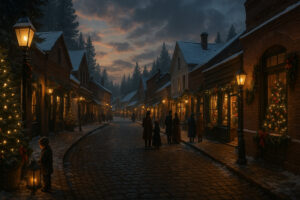
The chill of December air carries a faint scent of pine and wood smoke as lanterns glow along brick streets. It’s not a movie set — it’s Nevada City, California, where every winter the town transforms into a living Victorian postcard. Experiencing a Victorian Christmas in Nevada City offers a magical glimpse into the past. For travelers exploring Nevada’s wider heritage trail, this small Gold-Rush-era community sits just beyond the state line, linking the Sierra foothills to Northern Nevada’s cultural heartbeat.
Here, Christmas unfolds as it did more than a century ago. Shopkeepers greet visitors in waistcoats and bonnets; brass bands perform carols beside wood-burning stoves; and children press faces against frosted windows to watch toy trains circle tinsel-wrapped trees. For anyone seeking authenticity rather than artificial lights, Victorian Christmas in Nevada City offers one of the most immersive holiday experiences in the American West.
If you’re crossing into Nevada for more living history, start with Historic & Cultural Experiences in Nevada. Pair this Sierra celebration with festive traditions in Northern Nevada towns for a full holiday circuit. Spend an urban heritage day via things to do in Reno. Plan your scenic drive using scenic USA road trips for every season.
The Origins of a Gold-Rush Christmas
From Frontier Camp to Festive Town
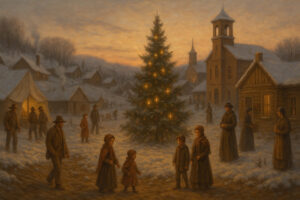
Nevada City began in 1849 when prospectors discovered gold in Deer Creek. Within months, tents and shanties covered the hills. By the 1850s, miners from Ireland, Cornwall, and Germany brought their own Christmas customs — Yule logs, plum puddings, and evergreen boughs. When the mines slowed and families settled, the rough camp matured into a proper town complete with churches, schools, and holiday socials advertised in the Nevada Journal.
Letters from that period describe hand-made gifts carved from wood, stockings hung near crude fireplaces, and small dances held in boarding-house halls. These early celebrations were humble but heartfelt. When railroads arrived in 1870, new goods from San Francisco and London added a touch of Victorian refinement — china ornaments, peppermint sticks, and sheet music for “God Rest Ye Merry Gentlemen.”
The 1970s Revival
By the mid-20th century, Nevada City’s downtown had faded. Then in 1978 a group of residents, inspired by Dickens fairs in San Francisco, revived the old-fashioned street festival. They named it “Victorian Christmas” to honor the architecture and spirit that survived the Gold Rush. Local teachers sewed costumes; shop owners lit candles instead of neon; and choirs volunteered to sing carols. That grassroots effort sparked an annual tradition that now draws thousands each December.
Today’s festival mirrors those early ideals — community first, commerce second. It proves that when a town values its history, tourism becomes preservation rather than performance.
A Town Transformed: The Atmosphere of Victorian Christmas
Architecture as a Stage
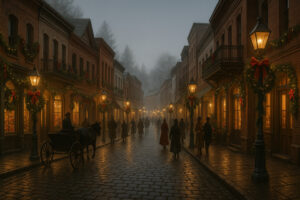
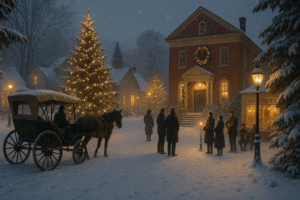
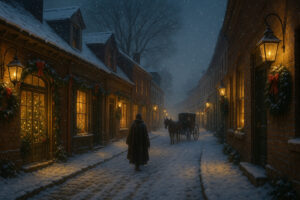
Nevada City’s compact downtown, centered on Broad Street, still carries its 1850s layout. Two-story brick buildings with iron shutters, narrow balconies, and painted cornices line the street like a theater set awaiting actors. During December, volunteers drape the façades in cedar garlands and crimson ribbons. Gas-style lamps cast honey-colored light over the cobblestones, turning every reflection into a painter’s study in amber and gold.
Each detail obeys authenticity. Electrical cords are hidden; decorations use natural greenery; and music comes from live instruments — never speakers. The effect is subtle yet powerful: you walk through history rather than observe it.
Sounds and Smells of the Season
Approaching downtown, visitors first hear bells from the Methodist Church, then the rhythmic clip-clop of horses pulling carriages. Vendors roast chestnuts in iron pans; cider simmers in copper kettles. The mingling aromas of pine, cinnamon, and smoke seem to slow time itself.
Street performers greet crowds with “Good evening, madam!” and “Happy Christmastide!” Children ride hay wagons, their laughter echoing between brick walls built before their great-grandparents were born. Even when snow fails to fall, light mist rising from Deer Creek gives the night a soft shimmer.
The Role of Community
Behind every wreath stands a neighbor. Students from Nevada Union High School form brass ensembles; local quilters sew banners; firefighters manage lantern safety. The town closes streets not just for tourists but for itself — for families who have celebrated together for generations. This intimacy differentiates Nevada City from larger Christmas markets. It’s not a show staged for outsiders; it’s an invitation into the community’s living room.
Festival Highlights on Broad Street
Where to Begin
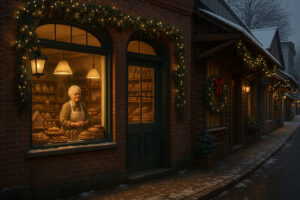
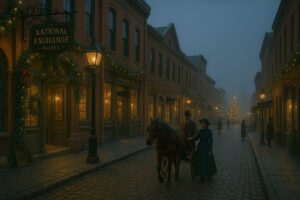
Start at the bottom of Broad Street near the historic National Exchange Hotel, reopened after a decade-long restoration. From there, stroll uphill past gift shops and bakeries glowing with candlelight. At the top, Trinity Episcopal Church hosts choral recitals that blend sacred hymns with folk carols brought by Cornish miners.
Along the way you’ll encounter:
Artisan Booths selling hand-poured candles, wool scarves, and tin toys.
Street Musicians performing fiddle tunes and waltzes.
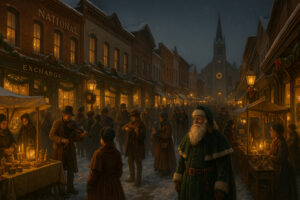
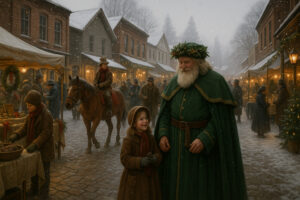
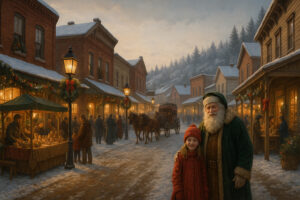
Victorian Santa Claus, whose green velvet robe reflects the original 19th-century depiction before the red-suit Coca-Cola era.
Each stall tells a micro-story of craftsmanship: blacksmiths hammer trivets over portable forges; glassblowers shape ornaments beside gas heaters; bakers glaze fruit loaves with brandy as steam curls into the night.
The Nevada Theatre and Holiday Performances
Built in 1865, the Nevada Theatre is California’s oldest operating playhouse. During December it becomes the festival’s cultural heart. Inside, velvet curtains rise on productions of A Christmas Carol and The Nutcracker Express — local adaptations that mix humor and nostalgia. The audience sings along; actors greet viewers afterward at the lobby fireplace.
For travelers, attending a performance here feels essential. The creak of wooden seats, the smell of old stage paint, and the faint chill seeping through stone walls merge into something unforgettable: the sensation of watching art within history.

Music Everywhere
Carols accompany each corner. The Nevada County Concert Band, the Miners’ Foundry Chorale, and traveling bagpipers rotate sets to keep energy constant. When “O Holy Night” rises above the crowd and the lamps flicker, conversation halts. Even those who came for shopping stand still, realizing they’re witnessing more than entertainment — they’re part of a century-long continuity of sound.
Street fiddlers favor Irish reels, reminding visitors of the immigrant roots that built the town. Between sets, you may hear storytellers recount how miners spent Christmas Eve sharing one candle between cabins. The blend of melody and memory forms the festival’s rhythm — joy balanced by history.
The Taste of a 19th-Century Holiday
Nevada City’s eateries adapt their menus to the season. At Lefty’s Grill you’ll find shepherd’s pie with local lamb; Three Forks Bakery offers mincemeat tarts dusted with powdered sugar; and The Curious Forge serves buttered rum in pewter mugs. Street vendors sell roasted almonds, gingerbread cookies, and spiced cocoa thick enough to coat spoons.
Food becomes storytelling: recipes come from pioneer diaries and Cornish cookbooks preserved by families. Many restaurants credit early settlers for the flavors still loved today — simple, hearty, and made to warm cold nights.

Evening Magic: The Carriage Ride
As twilight deepens, lines form for horse-drawn carriages. Blankets drape over knees while drivers narrate history — which building once held a brothel, which corner burned in 1856, which window still flickers from a gas lamp original to the 1880s. The slow pace allows time to notice the details: icicles hanging from gutters, reflections of wreaths in shop glass, and children waving candles like tiny stars.
When the horses pause at the courthouse square, the bells ring again, marking six o’clock. Some travelers linger for photos; others simply breathe in the scent of pine and wood smoke, grateful that such moments still exist in an age of screens and speed.
Local Artisans and Craft Traditions
Handmade Heritage: Keeping 19th-Century Skills Alive
Behind each candlelit stall on Broad Street stands a story of dedication. Nevada City’s festival depends on artisans who still use hand tools their ancestors would recognize. Step inside the old Foundry Exchange Hall and you’ll find blacksmiths hammering scrolls for wrought-iron wreath hooks. Nearby, glassblowers shape ornaments from recycled bottles, their breath turning shards into shimmering spheres.
Many of these craftspeople work year-round preparing inventory for the three-week festival. Each item—hand-carved toys, beeswax candles, lace bonnets—reflects the principle that Christmas should be handmade, not manufactured. It’s the opposite of fast shopping; here, patience becomes artistry.
The Blacksmiths of Deer Creek
Among the festival’s most popular demonstrations are the blacksmiths who operate portable forges outside the old Firehouse Museum. Sparks fly as hammers ring against anvils, and curious children cluster behind safety ropes to watch. One of them, Master Smith Tom Galvin, explains the symbolism: “Heat and effort shape metal, just like time shapes community.”
Each year he crafts a limited series of wrought-iron angels and horseshoes stamped “NC XMAS.” Proceeds fund repairs for downtown’s original lampposts. It’s a small circle of generosity—heritage supporting heritage.
Textiles, Glass, and Wood
Inside Miners’ Foundry Cultural Center, textile artists spin wool dyed with walnut and madder root. Visitors watch scarves emerge from hand-powered looms while seamstresses demonstrate Victorian embroidery techniques such as feather stitch and couching.
Woodcarvers from nearby Grass Valley bring cedar blocks that soon reveal toy soldiers, nutcrackers, and chess sets. Each craftsman signs pieces in pencil rather than ink—a tradition dating back to the 1860s when miners carved by candlelight after work.
A reviewer on TripAdvisor wrote: “There is regular local music here and a full bar … It is a nice venue, although the parking is hard to find.”
Explore Miners’ Foundry Cultural Center on Google Maps
The Spirit of Sustainable Crafting
Modern Nevada City embraces sustainability, so most artisans source materials locally. Beeswax comes from Sierra foothill apiaries, and fabrics are woven from California wool. The festival encourages waste-free packaging: paper instead of plastic, reusable ribbons instead of synthetic bows.
Travelers who buy these crafts take home more than souvenirs—they carry tangible reminders that tradition and environmental care can coexist beautifully.
Family and Traveler Experiences
A Day in the Life of a Visitor
Arrive by noon when the winter sun still warms the cobblestones. Begin at the downtown plaza where volunteers hand out printed maps styled like old parchment. As carolers rehearse nearby, stroll toward the vendors’ lane and order a mug of hot apple cider spiced with cloves.
Afternoons belong to families: pony rides for children, craft booths where youngsters decorate pine-cone ornaments, and photo corners featuring Father Christmas in emerald robes. Parents linger at antique shops or watch street performers reenact “A Christmas Carol” in five-minute sketches.
When twilight arrives, the atmosphere shifts. Lanterns glow brighter, music deepens, and couples wander arm-in-arm toward the National Exchange Hotel for dinner under chandeliers. Outside, the first chords of “O Come All Ye Faithful” echo through the crisp air, marking the festival’s nightly finale.
According to TripAdvisor — “Many travelers praise its central location … and its unique atmosphere, which combines vintage character with modern amenities.”
For Families with Children
Victorian Christmas was built for wonder. The Children’s Corner inside the Firehouse No. 1 Museum lets kids try on period costumes and stamp wax seals on mock letters to Santa. The city library hosts storytelling sessions where volunteers read from Little Women and The Night Before Christmas.
For quieter moments, families walk to Pioneer Park, where evergreen branches form natural arches over snowy trails. Children can watch deer grazing near the creek, adding a hint of wilderness to the holiday scene.
Romantic Getaways and Couples’ Moments
Couples find their rhythm in slower steps. The National Exchange Hotel’s restaurant, Lola, serves a prix-fixe Christmas Eve menu featuring roasted duck and Sierra mushroom risotto. After dinner, guests sip mulled wine in the lounge as pianists play Victorian waltzes.
For something quieter, partners stroll up Boulder Street to see lights reflected in shop windows, then pause on the bridge over Deer Creek. The combination of rushing water, distant carols, and cold air feels cinematic—romance written in candlelight.
Explore National Exchange Hotel on Google Maps
Tips for Travelers
Arrive early: Parking fills quickly by 1 p.m.; shuttle buses run from Nevada Union High School.
Book lodging months ahead: Historic inns sell out before Halloween.
Dress in layers: Evenings can drop to freezing.
Carry cash: Some vendors prefer exact change.
Be patient: Half the magic lies in waiting—for music to start, for lights to flicker on, for snow that may or may not fall.
Travelers often remark that Nevada City slows them down in the best way possible. In a world obsessed with instant gratification, waiting for the church bells to chime feels revolutionary.
Cultural Connections Between Nevada City and Northern Nevada
Although Nevada City sits on the California side of the Sierra Nevada, its culture has always intertwined with Northern Nevada. During the Comstock boom of the 1860s, stagecoaches carried not only ore but also ideas between Virginia City and Nevada City. Letters from merchants record how silver miners crossed the mountains for winter fairs, bringing along songs and recipes.
As railroads expanded, cross-border trade flourished. Bakers in Carson City ordered spices from Nevada City’s import shops; meanwhile, Nevada’s blacksmiths supplied tools for Sierra lumber mills. Out of this exchange grew a shared celebration culture—Victorian values of craftsmanship, charity, and community service.
Virginia City’s Christmas on the Comstock
Two hours east, Virginia City hosts its own December celebration known as “Christmas on the Comstock.” Gas lamps line the Boardwalk, and locals in bonnets sell gingerbread from barrels. The festival is smaller but grittier—a working mining town’s answer to Nevada City’s elegance. Visitors often combine both events in one trip, driving the historic Route 20 corridor across Donner Pass to experience two states of heritage in a single weekend.
Joint marketing by tourism boards encourages this “Twin Victorian Trail,” linking the Gold Rush and Silver Rush eras. Brochures highlight shared features—steam rail rides, period hotels, and holiday concerts held in century-old churches.
Carson Valley and Genoa’s Warm Hospitality
South of Carson City, the town of Genoa echoes Nevada City’s intimacy. Its Christmas Kick-Off Festival begins with a tree-lighting ceremony outside the old Mormon Station and ends with a community dance in the town hall. The same values shine through—volunteerism, handmade gifts, and music played by local students. Genoa’s historic bar serves spiced cider while a brass trio plays under gas lamps almost identical to Nevada City’s.
Gardnerville adds Basque flair with holiday menus featuring lamb stew and red wine served family-style. Together, these towns form a network of heritage celebrations across the Sierra frontier.
How Tourists Link the Two Regions
Travelers often plan loop routes: Reno → Carson City → Genoa → Nevada City → back via Truckee. This circuit covers less than 300 miles but crosses two state cultures and a century of history. Heritage maps now mark it as the “Victorian Christmas Corridor.”
Local businesses collaborate too. Bakeries in Ely sell “Comstock Cookies” using Nevada City recipes, while artisans exchange stock for joint online shops. Through shared promotion, they prove that cultural tourism thrives on connection rather than competition.

The Victorian Christmas in Nevada City and its Nevada counterparts generate millions in seasonal revenue for small businesses. Hotels reach full capacity, artists sell out of inventory, and donations fund restoration of historic buildings. Beyond money, these events preserve identity. When young volunteers dress in period costumes, they absorb history through participation.
Sociologists from the University of Nevada have even studied how heritage festivals strengthen rural communities. Their findings show that towns hosting annual cultural events retain higher rates of small-business ownership and civic engagement. In simpler terms: celebrating the past helps secure the future.
Whether you’re standing beneath Genoa’s tree lights or Nevada City’s garlanded balconies, one emotion links them—kindness. These towns remind travelers that community spirit is a renewable resource. Every cup of cider, every carol, every smile between strangers keeps heritage alive.
The Victorian Christmas movement may have started as nostalgia, but it evolved into a philosophy: a belief that tradition only matters when it includes everyone. That shared inclusiveness bridges state lines and centuries with remarkable ease.
Culinary Heritage and Historic Businesses
Flavors of the Past: Eating Like It’s 1890
Food is memory made edible, and in Nevada City that memory tastes like cinnamon, smoke, and sweet butter. Many eateries trace recipes to the Gold-Rush era when miners craved hearty fare after long days in the diggings. Today, chefs revive those flavors with refined technique, reminding diners that history can live on a plate.
Step into Matteo’s Public and you’ll smell slow-roasted game seasoned with juniper. The restaurant’s owners source ingredients from Sierra foothill farms, echoing Victorian self-sufficiency. A few doors down, The Curly Wolf Espresso House serves coffee roasted in small batches over wood fire, replicating the aroma that once filled saloons.
During the festival, nearly every menu includes a 19th-century nod: fig pudding, Yorkshire roast, or brandy-soaked fruitcake. Servers dress in lace aprons and waistcoats, offering table service by candlelight.
The Bakers of Broad Street
Each December, Nevada City’s bakeries become storytellers. Treats Nevada City displays shelves of gingerbread people in period costume, while Flour Garden Bakery recreates Cornish pasties stuffed with potato and beef. Visitors can join workshops on Victorian confections, learning how to make marzipan fruits dyed with natural beet pigment.
A longtime local named Eleanor Hastings, whose family has baked in the area since 1912, explains that every pastry carries symbolism. “Sugar was rare here once,” she says. “Sharing sweets meant sharing prosperity.” That spirit endures: bakeries donate unsold goods each night to community shelters.
On TripAdvisor (also referencing broader downtown context) visitors say the area has “over 90 preserved buildings … a vintage charm” that complements holiday events.
Explore Broad Street on Google maps
Historic Inns and the Taste of Hospitality
The National Exchange Hotel doesn’t just house guests; it stages time travel. Its dining room features pressed-tin ceilings, velvet drapes, and a pianist who plays carols from handwritten scores. Chef Wesley Martin blends modern flavors with nostalgia—duck confit paired with cranberry port glaze, served beside spiced carrots in antique china bowls.
Across the street, New Moon Café offers vegan reinterpretations of Victorian staples, proving sustainability can coexist with heritage. Both establishments emphasize local wines from nearby vineyards that date back to 1850s settlers.
Souvenirs Worth Keeping
Before leaving, travelers often browse Kitkitdizzi, a boutique specializing in locally made soaps, candles, and herbal tonics. The scent of pine and sage inside the store embodies the Sierra Nevada itself. Every purchase supports regional artisans, keeping profits circulating within the community.
Buy a small bottle of cedar oil or a bar of lavender soap—its fragrance will later transport you back to lantern-lit nights and snow-dusted roofs.
Traveler Itinerary: Two Days of Victorian Wonder
Day 1 – Arrival and Immersion
Morning:
Arrive via Highway 49 from Auburn. Check into the National Exchange Hotel or the Broad Street Inn, both walking distance from festival grounds. After unpacking, enjoy brunch at Three Forks Bakery & Brewery—try the smoked-salmon tartine with poached egg.
Afternoon:
Begin exploration at the Firehouse No. 1 Museum for historical context, then follow the bell sounds toward Broad Street. Watch artisans craft toys and lace, chat with them about techniques, and sample roasted chestnuts from roadside pans. Visit small art galleries tucked behind iron gates; they often host winter exhibits featuring Sierra landscapes.
Evening:
Reserve seats at the Nevada Theatre for A Christmas Carol Reimagined. After the performance, step into Lola at the National Exchange Hotel for dinner by candlelight. Walk back to your inn beneath the garlands—bells ringing, mist rising off Deer Creek.
Day 2 – Nature and Nostalgia
Morning:
Start with a hike along the Deer Creek Tribute Trail—less than two miles yet rich in scenery. Icicles cling to mossy bridges, and the silence contrasts perfectly with last night’s carols. Back in town, enjoy breakfast at Heartwood Eatery before browsing antique shops like Mélange for a Vintage Home.
Afternoon:
Drive ten minutes to Grass Valley’s Empire Mine State Historic Park. Explore mansion interiors decorated with period ornaments and learn how miners celebrated Christmas underground with candles stuck in helmets. Return to Nevada City for late-afternoon tea at Tea Light Café, where mismatched porcelain and piano melodies evoke 1880 England.
Evening:
End your journey with a carriage ride through softly falling snow (if fortune favors). Afterward, enjoy one last cider near the town tree as musicians perform the final hymn of the season. Stand quietly when the crowd sings “Silent Night.” It’s the closest modern life comes to peace.
Final Reflections: The Meaning of a Victorian Christmas
A Victorian Christmas in Nevada City is less about spectacle and more about sincerity. It shows how nostalgia can become renewal when handled with care. Each candle lit in a shop window isn’t just decoration—it’s a pledge to remember community, craftsmanship, and compassion.
Travelers leave with more than photos; they carry a shift in rhythm. After a weekend here, modern noise feels harsher, digital lights too bright. You begin to crave wooden toys over plastic, hand-written cards over texts, shared songs over streaming playlists. That’s the quiet revolution this little town inspires.
When you drive away along the snow-lined highway toward Reno or Sacramento, the sound of bells follows faintly in your mind. You realize you’ve stepped not back in time but forward—toward a slower, kinder way of being.
Closing Line
Victorian Christmas in Nevada City is more than an event—it’s a heartbeat echoing through history. Every December, that heartbeat grows louder, reminding travelers that joy isn’t found in novelty but in remembering who we once were and who we still hope to be.
Frequently Asked Questions About Victorian Christmas in Nevada City
The event typically runs over five evenings and two Sundays each December. Exact dates vary, so visitors should check Nevada City Chamber of Commerce for the current schedule.
Admission is free. Parking shuttles may cost a small fee, and donations to local charities are encouraged.
Layers are essential—temperatures often drop below freezing at night. Waterproof boots and gloves keep you comfortable while walking on cobblestones.
Yes, leashed pets are welcome outdoors, though not inside historic buildings or performance halls.
Downtown slopes are steep but manageable. Many businesses provide ramps and accessible restrooms; shuttle drivers offer priority seating for mobility needs.
Historic options include the National Exchange Hotel and Broad Street Inn. Modern accommodations can be found in Grass Valley and Auburn.
Yes. Many travelers plan weekend itineraries covering both events across the Sierra—about a three-hour drive apart.
Authenticity. Everything—from hand-sewn costumes to live music—comes from local volunteers. It’s a living tradition rather than a commercial show.
Yes. Events proceed in most weather conditions; snow adds magic, rain adds reflection, and locals say, “Christmas feels real when the air smells of earth.”
Shop local, donate to the Nevada County Historical Society, and share responsible travel stories that honor the region’s heritage.