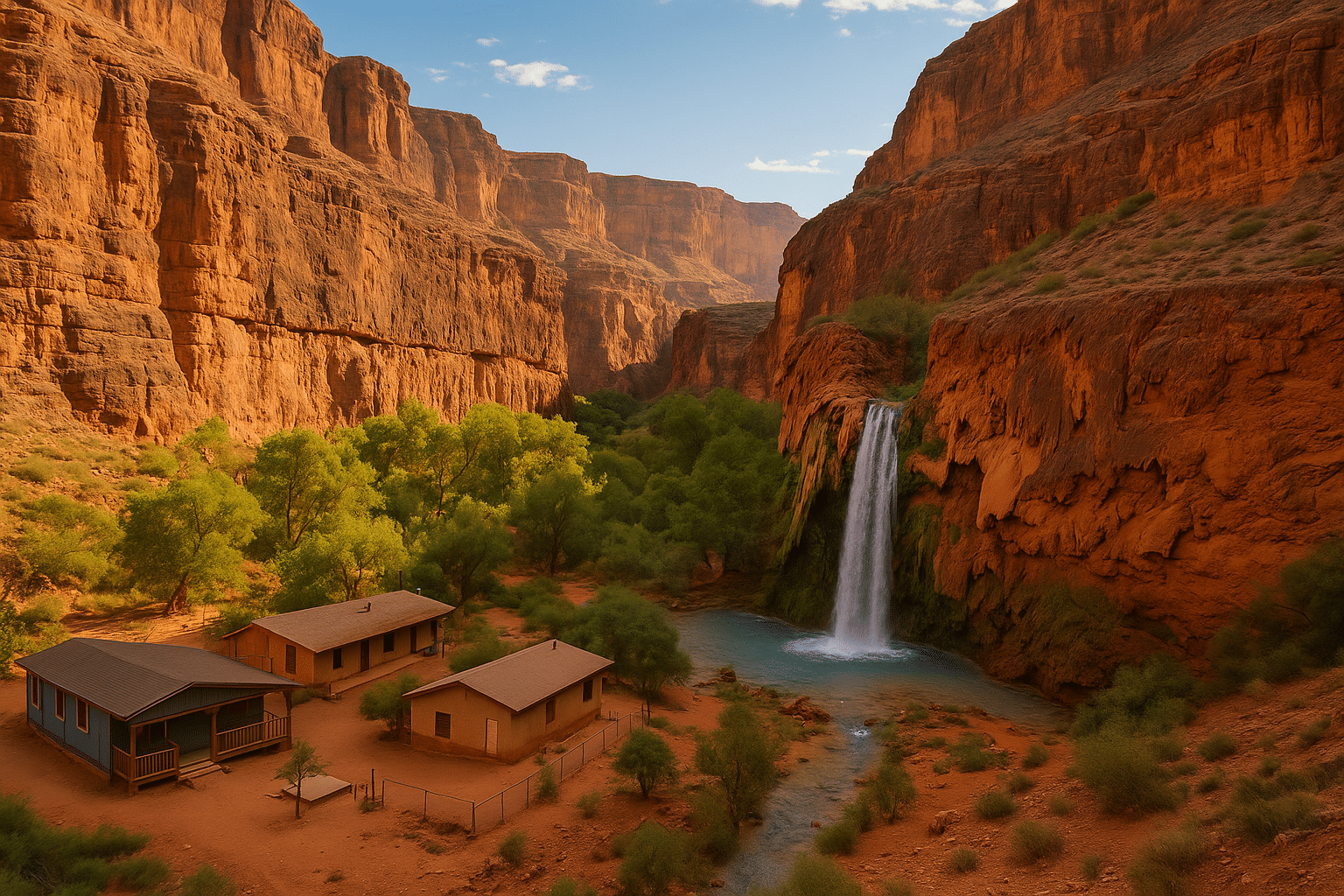
Reaching Supai feels less like a simple trip and more like stepping into another world. Hidden deep within the Grand Canyon on the Havasupai Indian Reservation, the village sits at the end of an eight-mile hike, a mule ride, or a helicopter flight. That effort alone makes arriving here unforgettable—you don’t just arrive; you earn it. The moment you step onto the dusty paths, you notice how quiet it is compared to the outside world. Life moves at a slower pace, shaped by red canyon walls, turquoise water, and traditions that have lasted for centuries.
Visitors usually come here to see Havasu Falls, and I can honestly say no photo does it justice. But staying in Supai is about more than chasing waterfalls—it’s about experiencing a place where the mail is still delivered by mule, where nights are filled with stars instead of streetlights, and where community feels woven into the very land.
Whether you spend the night at the Supai Lodge, camp beside rushing falls, or stay in a nearby town before your trek, your choice of where to sleep will shape how you experience this rare destination. Supai isn’t just a place to visit; it’s a journey into one of America’s most hidden corners, and it leaves you with stories you’ll carry long after you leave the canyon.

Tucked away at the bottom of a canyon in northern Arizona is a place that feels almost like another world, Supai Village. It’s not the kind of destination you stumble across by accident. To get here, you have to hike miles into the desert, ride a mule along winding canyon trails, or take a helicopter from the rim.
That remoteness is exactlywhat makes Supai so special. Life here moves at a slower pace, rooted in tradition, surrounded by sandstone cliffs, and forever shaped by the waterfalls that have drawn travelers for generations. When you arrive, it doesn’t take long to realize Supai is unlike anywhere else in the United States. This is the only community in the country where the mail still arrives by mule, and the rhythm of daily life feels far removed from the noise of modern cities.
Visitors come here for the chance to see Havasu Falls, one of the most stunning waterfalls in the world, but staying in Supai is about more than just checking off a bucket-list sight. It’s about experiencing a village that has preserved its way of life for centuries.
Of course, before you can enjoy all of that, you’ll need to figure out where to stay. And that’s not as easy as it sounds. Supai doesn’t have rows of hotels or resorts waiting for tourists. In fact, there’s just one main option inside the village: Supai Lodge. It’s a simple, no-frills kind of place, but it gives you what matters most, a bed, a roof, and the chance to wake up already in the canyon.
From there, it’s just a short walk to the trail that leads to Havasu Falls. If you’ve ever dreamed of watching the sunrise spill across red cliffs before setting off toward turquoise-blue water, this is the spot to do it.For those who crave a little more adventure, the Havasupai Campground is another option.
Nestled between. Havasu Falls and Mooney Falls, it’s one of those rare places where you can fall asleep to the sound of rushing water and wake up under a sky so full of stars it barely seems real. But getting a spot here isn’t easy, permits are limited and sell out quickly each year. Planning ahead isn’t just smart, it’s essential.
If you can’t secure a room in the lodge or a camping permit, don’t worry. Many travelers choose to stay in towns near the trailhead, like Peach Springs or Seligman. These spots don’t put you right in the canyon, but they do make it easier to start your hike fresh and rested. They’re also a good backup if everything in Supai itself is booked.
No matter which option you choose, your accommodations will shape your entire Supai experience. Staying in the canyon means you get more time by the waterfalls and a closer connection to the land. Staying nearby means an early start and the chance to explore without rushing.
Either way, it’s about more than just a place to sleep, it’s the beginning of a journey into one of the most hidden and unforgettable corners of America. Supai isn’t just a stop on the map. It’s a story you’ll carry with you long after you’ve left the canyon behind.
Introduction to Supai Village
If you’ve ever dreamed of visiting a place where time seems to stand still, Supai Village is that rare destination. Tucked deep in the Grand Canyon on the Havasupai Indian Reservation, it’s often called the most isolated village in the U.S. What makes it truly unique isn’t just the setting — it’s the journey.
Supai is not reached by car; you must hike eight miles, mule ride in, or helicopter in to reach it. That bit of work makes arriving there feel like entering a world few ever see. Supai is home to the Havasupai tribe, whose name means “people of the blue green water.” That pretty much tells you everything about the region’s famous turquoise waterfalls and streams that flow through red canyon walls.
The Havasupai people have lived here for generations, and their calm, enduring way of life continues to the present day. There are no chain restaurants or frenzied distractions here—only dusty roads, simple buildings, and authentic warmth. Life here is ruled by the sun, river, and ancient tales passed down generation after generation.
Visitors come not just for the waterfalls but for a deeper experience. The village offers a rare look at how a community thrives in isolation. There’s a small café, one grocery store, and mail still delivered by mule—details that highlight how untouched Supai remains. Walking through the village, you’re not in a tourist attraction but part of a living, enduring culture.
The waterfalls—Havasu, Mooney, Beaver, and Navajo Falls—are all within hiking distance from the village. Overnighting allows you to do it at your own speed, swim between the turquoise pools, and return as the stars fill the evening sky. It’s a more realistic, slower experience than any day trip could offer.
Supai also fosters a sense of connection. Whether you’re chatting with fellow hikers at the café or watching mule trains carry supplies, there’s a shared sense of journey and discovery. Many leave with not just memories, but new friendships. Supai is not easy to get to, and that is what makes it unforgettable. The trip takes work and a respect for the land and its people, but the payoff is an experience that lingers. Supai provides not only beauty, but perspective,
connection, and a tale worth telling.

Supai Lodge
If you’re lucky enough to stay overnight in Supai Village, you’ll likely find yourself at Supai Lodge. This small lodge isn’t about luxury — it’s about being in the heart of one of the most remote communities in America. With just a handful of rooms, it’s the only hotel in the village, and securing a reservation feels like discovering a hidden treasure.
After hours of hiking in or helicopter rides into the canyon, arriving at the lodge is like finally arriving home to a sanctuary deep within the canyon. The lodge is basic, and that is just its charm. There are no flat-screen TVs, spa slippers, or room-service menus —just a clean bed, air conditioning, bathrooms inside the rooms, and a peaceful place to sleep after walking through waterfalls and trails.
The absence of distractions — no ringing phones or blaring televisions — allows you to completely immerse yourself in the natural setting: the rush of the wind through the canyon, the noise of hikers walking by outside, and the clip-clop of mules that carry supplies.
Location is one of the lodge’s best features. The hike to Havasu Falls begins right within the village, mere feet from your room. You can get up early, enjoy a cup of coffee from the café, and get on the trail without enduring the chaos day-trippers have to go through. Sleeping in the lodge gives you time — time to soak up waterfalls, wander through the canyon at your own pace, and be fully present in a place like no other.
Reservations are tough, opening months in advance and booking up quickly. Travelers compare booking a room at Supai Lodge as a dash — but if you are able to accomplish it, it rearranges the trip. Having a cool, clean room waiting after miles of backpacking is more than reassurance.
The lodge also fosters a sense of community. At dusk, individuals gravitate outside, swapping trail stories, trading waterfall information, or laughing at the stars. You meet travelers from all corners of the world, all of whom traveled to this Arizona secret.
Down-to-earth comforts — air, electricity, hot running water — are a luxury here. What truly sets Supai Lodge apart, however, is the manner in which it immerses you in canyon living. You’ll see mule trains, catch a glimpse of local life, and watch cliffs emit ever-changing hues of red as the sun crosses the horizon.
Supai Lodge isn’t just a place to sleep; it’s the doorway into the village’s magic. It’s where your waterfall adventure begins and ends, and it becomes part of your Supai story — a story you’ll want to tell again and again.

Room Types & Rates at Supai Lodge
The first thing you have to know about Supai Lodge is that it is not your average hotel. No high-gloss lobbies, no spa therapy massages, and no fancy breakdown of room styles. No, the lodge is just down-to-earth—and that is exactly what makes it special. With only 24 rooms, booking a room is like winning a lottery. It’s also the only lodge in Supai Village, which is located in the heart of the Grand Canyon.
All the rooms have the basics: two doubles, private bathroom with shower, air conditioning, and simple furniture. No bells or whistles, but after backpacking eight miles into the canyon, those beds and clean sheets are pure bliss. The air conditioning and the opportunity to wash off trail grit are luxuries in themselves. Few of these tourists are going to be here for five-star service—what they want is a warm night’s sleep after long, unforgettable days seeing waterfalls and canyon trails.
The price generally runs between $200 and $250 a day. On the surface, that seems too much for modest accommodations. But consider the logistics—equipment brought in by mule or helicopter, limited availability, and the location’s remoteness—and it starts to make sense. In addition, travelers pay the Havasupai Tribe admission and environmental charge, which goes directly into taking care of the trails, the waterfalls, and the folks. In essence, portion of your visit puts this place on life support.
Booking a room at Supai Lodge can be tricky. Reservations open once a year online and sell out almost instantly. Travelers often compare it to grabbing tickets for a popular concert—you need to be online, prepared, and quick. That’s why securing a room feels like such a win: it guarantees you’ll wake up in one of the most remote and beautiful corners of the country.
There are no lounges or restaurants at Supai Lodge, but it makes up for it through ambiance. Supper is typically taken outdoors, snacking on snacks and comparing stories of how hard it was to get to the village. Strangers become friends, united through how difficult it was to reach there.
The actual worth of Supai Lodge isn’t in furniture or amenities—it’s in the experience. To spend time here is to be able to linger around Havasu Falls, visit Mooney Falls on your own terms, and return to a simple but welcoming sanctuary. It isn’t a hotel room; it’s a front-row seat in one of the most magical landscapes on the planet.