Some landmarks don’t need to be tall, flashy, or high-tech to make an impression. The Ocracoke Lighthouse proves that. At just 75 feet, it’s the shortest of the Outer Banks lighthouses—but it’s also the oldest still in operation, quietly watching over Silver Lake since 1823.
When I first saw it, tucked behind trees and a white picket fence, it almost felt like a secret. Unlike the dramatic black-and-white spiral of Cape Hatteras or the stately Bodie Island Lighthouse, Ocracoke’s tower is simple: a smooth white cylinder rising above the village. Yet its quiet presence has guided sailors for two centuries, and today it’s one of the island’s most beloved icons.
This guide will take you through everything you need to know about the Ocracoke Lighthouse: its history, design, how to visit, and what to expect. Whether you’re a history buff, a lighthouse enthusiast, or just someone looking for the perfect Ocracoke photo, the lighthouse deserves a spot on your itinerary.
The History of Ocracoke Lighthouse
Built in 1823
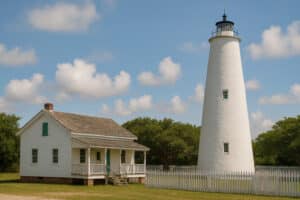
The Ocracoke Lighthouse was built in 1823, making it the oldest operating lighthouse in North Carolina and the second-oldest in the United States still in use. It replaced an earlier wooden lighthouse built in 1798 on nearby Shell Castle Island, which had been destroyed by lightning.
The U.S. government recognized Ocracoke Inlet as one of the most important shipping channels along the East Coast. Ships heading for mainland ports had to pass through these tricky waters, and a reliable light was crucial for safe navigation.
Early Years of Operation
In the 1800s, lighthouse keepers lived in simple cottages near the tower, tending the light by hand. Every evening, they climbed the narrow spiral staircase to light the oil lamp, and every morning, they extinguished it. Keeping the light steady in stormy weather was demanding work.
The Ocracoke Lighthouse’s position at the entrance to Silver Lake Harbor gave it extra importance. It didn’t just guide ocean-going vessels—it also helped local fishermen and traders find safe passage into the island’s heart.
Civil War & Maritime Significance
Like many Outer Banks lighthouses, Ocracoke played a role in the Civil War. Confederate forces initially controlled the island and the lighthouse, but Union troops took over in 1861. After that, it remained in federal hands, continuing to guide naval and merchant ships.
The waters off Ocracoke have always been challenging. Shifting sandbars, shallow inlets, and powerful storms earned this stretch of coast the nickname “Graveyard of the Atlantic.” The lighthouse was a constant in an environment that could change overnight.
From Oil to Electricity
In its earliest days, the light was fueled by whale oil. Later, kerosene replaced oil, and in 1929, the lighthouse was converted to electricity. Today, its beacon still shines—a steady, non-flashing light visible up to 14 miles offshore.
Traveler’s Note
Standing at the base of the lighthouse, I couldn’t help but imagine what it was like for keepers 150 years ago, climbing the spiral stairs in the middle of a storm to keep the flame alive. The tower may be quiet now, but its history is anything but.
Architecture & Design of the Ocracoke Lighthouse
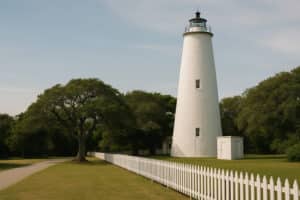
The Ocracoke Lighthouse may not be the tallest or the most ornate, but its design is part of what makes it so distinctive. Unlike many Outer Banks lighthouses that boast stripes, bold colors, or towering heights, Ocracoke’s simplicity reflects its practical purpose: to guide ships safely, not to impress.
Structure & Dimensions
Height: 75 feet tall, making it the shortest lighthouse on the Outer Banks.
Shape: A smooth, conical tower with slightly tapering sides.
Material: Built with bricks covered in a thick coat of lime, sand, and saltwater plaster, giving it its signature whitewashed look.
Staircase: A narrow spiral staircase leads to the lantern room, though the interior is rarely open to the public today.
Its smaller size means it didn’t require an external pattern (like Cape Hatteras’s stripes) to distinguish it. The simple white paint has been enough for mariners for two centuries.
The Lantern & Light
Original Lens: A simple oil lamp with reflectors.
Upgrades: Eventually replaced with a Fresnel lens, which dramatically improved the reach of its light.
Today’s Beacon: A steady, non-flashing light visible for up to 14 miles offshore. Unlike many lighthouses that blink or rotate, Ocracoke’s light is constant, making it unique among its peers.
Keeper’s Quarters
Beside the tower stands the Keeper’s House, built at the same time in 1823.
Design: A simple, wood-frame house painted white to match the lighthouse.
Use: Originally home to the lighthouse keeper and family.
Today: Privately occupied and not open to the public, but still part of the historic property.
The juxtaposition of the modest house and the cylindrical tower makes the site feel less like a monument and more like a lived-in piece of history.
Comparing Simplicity to Grandeur
The Ocracoke Lighthouse often surprises first-time visitors who expect a dramatic tower like Cape Hatteras or Currituck. But that’s what makes it memorable. Its plain white design feels understated and timeless, a reflection of the village itself.
Other lighthouses were built as much to stand out as to guide ships, but Ocracoke didn’t need flash—it needed reliability. Its enduring presence has made it a symbol of stability in an island landscape that changes constantly.
Insider Tip
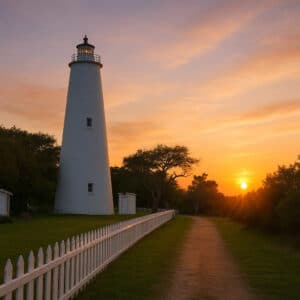
If you want the best photo of the Ocracoke Lighthouse, visit in the late afternoon. The soft golden light enhances the whitewashed tower, and the shadows from surrounding trees create a picture-perfect frame.

Visiting the Lighthouse Today
Unlike some lighthouses that are towering attractions with full visitor centers, the Ocracoke Lighthouse offers a quieter, more intimate experience. Visiting here feels less like touring a monument and more like stepping into a preserved corner of island history.
Explore Ocracoke Lighthouse on google maps
Accessibility & Parking
The lighthouse is located just off Lighthouse Road in Ocracoke Village.
Parking: A small gravel lot near the site provides a handful of spaces. During busy summer days, it fills quickly, so biking or walking from the village is often easier.
Walking Distance: From Silver Lake Harbor, it’s less than a mile, making it an easy stroll or bike ride.
Accessibility: The grounds are flat and easy to navigate, though the tower itself is not wheelchair accessible.
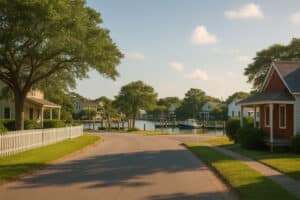
Many visitors choose to combine a stop at the lighthouse with a walk or bike ride through the village’s quiet back streets.
Exploring the Grounds
Visitors can walk right up to the base of the lighthouse.
White Picket Fence: The lighthouse is surrounded by a small white fence, adding to its quaint charm.
Keeper’s Quarters: Visible but privately occupied, so you can admire it from the outside only.
Trees & Shade: Large live oaks and cedars provide shade and a picturesque setting.
Unlike larger sites, there’s no ticket booth, no crowds, and no gift shop—just the lighthouse, the keeper’s house, and the quiet atmosphere.
Tours & Interior Access
One detail that surprises many visitors is that the Ocracoke Lighthouse is not generally open for climbing.
Interior: The narrow staircase and fragile structure make public access difficult.
Occasional Openings: On rare occasions, the National Park Service hosts special events where visitors may step inside, but this is the exception, not the rule.
What You Can Do: Walk the grounds, take photos, and appreciate the lighthouse from the outside.
While some travelers are disappointed they can’t climb to the top, many agree that the peaceful setting makes up for it.
Photo Opportunities
The lighthouse’s simplicity makes it one of the most photogenic spots on Ocracoke.
Daytime Shots: The whitewashed tower pops against a clear blue sky.
Sunset Glow: Late afternoon brings soft golden light.
Framing Ideas: Use the white fence, surrounding trees, or even the harbor in the distance to create unique angles.
Night Photography: The constant beam of light makes for striking long-exposure shots.
It’s not unusual to see visitors waiting for just the right light, especially photographers chasing the perfect postcard image.
Atmosphere of the Site
The Ocracoke Lighthouse isn’t crowded or commercial. Most visitors spend 15–30 minutes here, walking the grounds, taking photos, and reading the informational plaques. The quiet atmosphere gives you time to imagine what life was like when keepers tended the lamp by hand.
Great example of a small lighthouse. Very well preserved with volunteer guides to explain the lighthouse. Good parking just 90 feet down the street.
The volunteer at the Ocracoke Lighthouse did an excellent job describing the structure and the associated history of the lighthouse and of the area. It is an interesting piece of history and it is still in use.
Traveler’s Note
When I visited one spring morning, there were only a few other people around. The air smelled of salt and cedar, and the lighthouse seemed almost to glow in the early light. Unlike other tourist-heavy Outer Banks lighthouses, this one felt personal—like it was part of the village rather than separate from it.
Things to Do Nearby
Visiting the Ocracoke Lighthouse doesn’t take long—you could see the tower, walk the grounds, and snap a few photos in under 30 minutes. But its location in the heart of Ocracoke Village means you’re surrounded by other attractions worth exploring. Pairing the lighthouse with nearby spots turns a quick stop into a rich afternoon. For another moving historic stop, visit the British Cemetery.
The lighthouse is just one piece of the island’s story—discover more history, beaches, and experiences in our Ultimate Guide to Ocracoke Island.
Springer’s Point Nature Preserve
Just a short walk or bike ride from the lighthouse, Springer’s Point is one of Ocracoke’s hidden gems.
Trail: A half-mile path winds through maritime forest, salt marsh, and sandy shoreline.
History: This preserve is tied to pirate lore—legend has it that Blackbeard’s final battle took place near here in 1718.
Atmosphere: Quiet, shaded, and perfect for birdwatching or a picnic.
Many visitors combine a morning lighthouse stop with an afternoon hike at Springer’s Point.
Silver Lake Harbor
The lighthouse is only a short walk from Silver Lake Harbor, the heart of Ocracoke Village.
Views: Boats bobbing in the harbor make for a scenic stroll.
Dining: Several waterfront restaurants and pubs line the harbor.
Relaxation: Benches by the water invite you to sit, watch the boats, and soak up the atmosphere.
At sunset, Silver Lake is one of the most beautiful spots on the island—making it a natural pairing with lighthouse photos taken earlier in the day.
Ocracoke Village Shops & Galleries
After visiting the lighthouse, many travelers wander through the village shops.
Local Art: Galleries showcase paintings, photography, and crafts inspired by the island.
Unique Finds: Handmade jewelry, pottery, and nautical antiques.
Books to Be Red: A beloved independent bookstore that doubles as a cultural hub.
The shopping district feels small-town and personal, with none of the over-commercialization you find in bigger beach towns.
Dining Options Nearby
Food is never far from the lighthouse. Within a mile, you’ll find:
Howard’s Pub: Known for oysters and burgers, a casual favorite.
Dajio: More upscale, with seasonal coastal cuisine.
Ocracoke Coffee Company: A cozy spot for morning brews and pastries.
SmacNally’s Raw Bar: A waterfront hangout perfect for seafood lovers.
Stopping for lunch or dinner nearby rounds out a lighthouse visit nicely.
Other Village Landmarks
British Cemetery: A small, solemn site where British sailors from WWII are buried.
Village Boardwalk: A wooden boardwalk connecting parts of the harbor, ideal for a relaxing walk.
Local Churches: The historic Ocracoke United Methodist Church, with its simple white exterior, echoes the lighthouse’s understated design.
Moment to Remember
One afternoon, after photographing the lighthouse, I walked to Springer’s Point. The trail opened onto a quiet beach where I sat alone, watching pelicans dive into the water. Looking back toward the harbor, I could just glimpse the lighthouse through the trees—a reminder that Ocracoke is a place where history, nature, and daily life blend seamlessly.
Tips for Travelers
The Ocracoke Lighthouse may be small, but a little planning makes your visit smoother and more rewarding. Here are some practical tips to keep in mind before you go.
Best Time to Visit
Morning: Quiet and calm, with fewer visitors and soft light for photos.
Afternoon: Popular with day-trippers arriving by ferry, so expect more people.
Evening: Golden-hour light makes the whitewashed tower glow, perfect for photographers.
Off-Season: Spring and fall bring cooler temperatures and lighter crowds.
If you want photos without people, arrive early in the morning before most shops and restaurants open.
How to Get There
By Car: Once on Ocracoke Island via ferry, the lighthouse is a 5-minute drive from Silver Lake Harbor.
By Bike: One of the easiest ways to visit. Many visitors rent bikes in the village and ride the short distance.
On Foot: From the harbor area, it’s less than a 20-minute walk.
Parking Details
Lot Size: The gravel lot near the lighthouse has limited spaces—usually enough for a handful of cars.
Overflow Options: If it’s full, park in the village and walk or bike.
Accessibility: Spaces are close to the grounds, but the interior of the lighthouse is not wheelchair accessible.
What to Bring
Camera or Smartphone: The lighthouse is one of the most photographed spots on Ocracoke.
Water Bottle: Especially in summer—shade is limited.
Comfortable Shoes: The grounds are easy, but you may want to combine your visit with a village walk.
Bug Spray: Mosquitoes can be active in warm months, especially in shady areas near the trees.
What Not to Expect
No Interior Tours: The lighthouse is closed inside to the general public.
No Restrooms: Plan to use facilities in the village before or after.
No Gift Shop or Café: The lighthouse is about history, not commerce—shops and food are nearby in the village.
Combine with a Day Itinerary
A smart way to structure your day is:
Visit the lighthouse in the morning for quiet photos.
Head into the village for coffee and shopping.
Spend the afternoon exploring Springer’s Point or the beach.
Return to Silver Lake for a sunset harbor walk.
This way, the lighthouse becomes part of a relaxed, full-day Ocracoke experience.
Insider Tip
If you’re visiting in summer, bring a wide-brimmed hat. The sun reflects strongly off the white tower and surrounding sand, making it brighter than you’d expect.
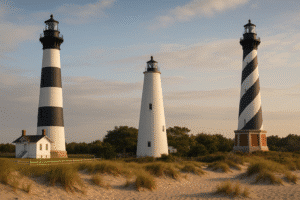
Comparisons to Other Outer Banks Lighthouses
The Outer Banks is home to some of the most iconic lighthouses in the United States. Travelers often plan road trips to visit all of them, and the Ocracoke Lighthouse is an essential stop on that trail. But how does it compare to its taller, flashier neighbors?
Ocracoke Lighthouse vs. Cape Hatteras Lighthouse
Cape Hatteras: At 210 feet, it’s the tallest brick lighthouse in the U.S. and famous for its black-and-white spiral stripes. Visitors can climb to the top for sweeping ocean views.
Ocracoke: At just 75 feet, it’s much smaller and simpler, with no stripes and no interior tours.
Experience: Cape Hatteras is a dramatic, tourist-heavy landmark. Ocracoke feels quieter and more personal—less about climbing and more about appreciating history.
Ocracoke Lighthouse vs. Bodie Island Lighthouse
Bodie Island: Built in 1872, Bodie Island Lighthouse stands 156 feet tall with bold black-and-white horizontal stripes. It offers guided climbs in season.
Ocracoke: Predates Bodie by nearly 50 years, but is smaller and more modest.
Experience: Bodie Island feels like a grand monument on the edge of marshlands. Ocracoke feels like part of a village.
Ocracoke Lighthouse vs. Currituck Beach Lighthouse
Currituck Beach: Built in 1875, it stands 162 feet tall and is distinctive for its unpainted red-brick exterior. Visitors can climb its 220 steps.
Ocracoke: In contrast, painted white and far shorter, with no climb.
Experience: Currituck feels stately and powerful. Ocracoke feels simple and approachable.
Ocracoke Lighthouse vs. Roanoke Marshes Lighthouse
Roanoke Marshes: A replica of a screw-pile lighthouse located in Manteo, with a small museum-like interior.
Ocracoke: Authentic and still in operation after two centuries.
Experience: Roanoke Marshes feels like a recreation of history, while Ocracoke is the real thing.
Why Ocracoke Stands Out
While it may not impress with size or stripes, the Ocracoke Lighthouse is unique:
Oldest in the Outer Banks still operating (built in 1823).
Only one with a steady, non-flashing light.
Deeply tied to village life, blending into its surroundings instead of towering above them.
For travelers, this makes it less of a climb-the-steps attraction and more of a cultural stop—an experience rooted in the island’s heritage.
Traveler’s Note
I’ve visited several Outer Banks lighthouses, but Ocracoke always felt the most authentic. At Cape Hatteras, I was impressed by the climb and the views; at Ocracoke, I was struck by the quiet—the sense that this little white tower has been here, unchanged, for two hundred years while everything else around it shifts.
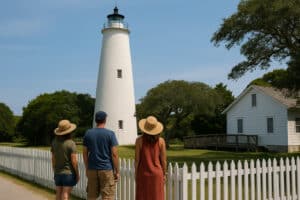
Who Will Love This Stop
The Ocracoke Lighthouse doesn’t demand much time, but it leaves a lasting impression. Different types of travelers appreciate it for different reasons.
Families with Kids
Children love the simplicity of the lighthouse.
The grounds are easy to walk, and the white tower looks almost like it came out of a storybook.
Parents appreciate that it’s quick, free, and doesn’t require a long climb.
The small size makes it less intimidating than other massive Outer Banks lighthouses.
For families, it’s a gentle introduction to lighthouse history.
History Buffs
For those interested in maritime heritage, Ocracoke Lighthouse is a gem.
Built in 1823, it predates most of its Outer Banks neighbors.
It played a role in guiding Civil War vessels.
It’s one of the oldest operating lighthouses in the U.S.
Even without climbing, standing at its base connects you to two centuries of seafaring history. Nearby Springer’s Point Preserve also connects to Ocracoke’s rich maritime story.
Photographers
This lighthouse may be simple, but it’s incredibly photogenic.
The whitewashed tower contrasts beautifully with blue skies, green trees, and golden evening light.
Seasonal variations—spring flowers, autumn leaves, winter sunsets—give it year-round appeal.
Night photographers can capture its steady beam against a star-filled sky.
Casual Visitors
Not every traveler wants a major time commitment.
A stop at the Ocracoke Lighthouse is free and takes less than half an hour.
Its location makes it easy to combine with shopping, dining, or a harbor walk.
Even if you’re not passionate about lighthouses, it’s a quick taste of Ocracoke’s charm.
Lighthouse Enthusiasts
For those collecting lighthouse visits, Ocracoke is a must.
It completes the Outer Banks lighthouse circuit.
Its history and unique constant light make it stand out in any lighthouse log.
Though you can’t climb it, its significance more than earns it a spot on the list.
Insider Tip
If you’re traveling with friends or family who aren’t as excited about lighthouses, frame Ocracoke as a quick, easy stop on the way to lunch or the harbor. They may not arrive thrilled—but they’ll almost always leave with photos and a smile.
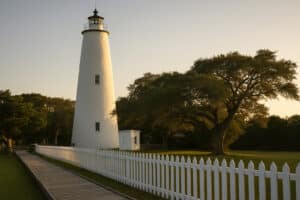
Traveler Stories & Impressions
The Ocracoke Lighthouse may be small and understated, but visitors consistently mention how memorable it is. Their stories reveal why this little white tower holds such a big place in Ocracoke’s heart.
The oldest, still working, lighthouse is on the island of Okracoke, a 70 minute (each way car ferry) ride from Hatteras. The site is very beautiful.
First Impressions
Many travelers say they’re surprised by the lighthouse’s modest size.
“I expected something as tall as Cape Hatteras, but instead I found this quiet, white tower tucked behind trees. It felt like discovering a secret.”
“It wasn’t grand, but it was beautiful in its simplicity. It fit the island perfectly.”
For some, that contrast between expectation and reality becomes the most charming part of the visit.
Families Visiting
Parents often share how easy the stop is with children.
“We biked over with our kids, and they loved running around the fenced lawn while we snapped photos. It was short and sweet, which is perfect with little ones.”
“Our teenagers weren’t thrilled about another lighthouse, but even they admitted it was one of the prettiest we saw on our Outer Banks trip.”
Photographers’ Highlights
Photography enthusiasts praise the lighting and angles.
“The late afternoon sun made the white tower glow. It was one of my favorite shots from our Outer Banks road trip.”
“Even though you can’t climb it, the grounds offered so many perspectives—framed by trees, by the fence, or just rising alone against the sky.”
History Buffs’ Reflections
Visitors drawn to heritage are often deeply moved.
“Knowing this lighthouse has been standing since 1823 made me pause. It’s older than most buildings in my hometown, and yet it still serves its purpose.”
“I thought about the keepers climbing those stairs every night with oil lamps, keeping the light alive through storms. You can almost feel their presence.”
Moment to Remember
On one visit, I watched as a couple posed for wedding photos in front of the lighthouse. The bride’s white dress seemed to echo the tower itself, glowing in the evening sun. It struck me then that the Ocracoke Lighthouse isn’t just a relic—it’s part of the island’s living story, woven into everyday life and memories.
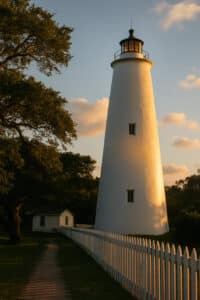
Conclusion – Why the Ocracoke Lighthouse Belongs on Your Itinerary
The Ocracoke Lighthouse may not tower over the shoreline or invite you to climb its steps, but that’s exactly why it stands out. Built in 1823, it’s the oldest operating lighthouse in North Carolina and one of the simplest—and most authentic—Outer Banks landmarks.
A visit here doesn’t take long. You’ll stroll up to the picket fence, admire the glowing white tower, snap a few photos, and maybe linger under the live oaks. But in that short time, you’ll feel connected to two centuries of maritime history and to the quiet character of Ocracoke Village itself. And if you’re curious about legends tied to the island, don’t miss Ocracoke’s ghost stories.
If your Outer Banks trip is about more than checking boxes—if you want to slow down and experience places that still feel true to their past—the Ocracoke Lighthouse deserves a spot on your list. It won’t shout for attention, but it will leave a lasting impression.