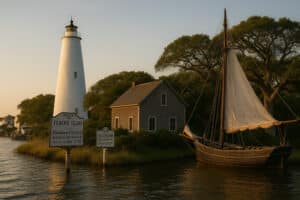
Step onto Ocracoke Island, and you’ll quickly feel that history lingers in the salt air. Beyond the beaches and village streets lies a past woven with shipwrecks, smugglers, lighthouse keepers, fishermen, and perhaps most famously—pirates. Among them, none looms larger than Blackbeard, whose dramatic final battle took place just offshore in 1718.
But Ocracoke’s story doesn’t end with pirate lore. The island has been home to Native peoples, mariners, soldiers, and fishing families who shaped its character across centuries. Today, visitors can trace that heritage through landmarks, museums, local traditions, and tales passed down from generation to generation.
This guide explores the history of Ocracoke, from its pirate legends to its role in trade and wartime, and how those stories continue to shape island life.
Explore the Map of Ocracoke’s Historic & Pirate Sites on google maps
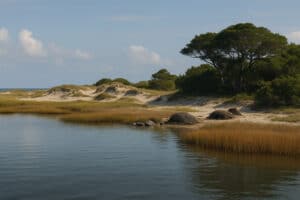
Ocracoke Before Blackbeard – Early Island History
Long before European explorers set foot here, Ocracoke was known to Indigenous peoples who used the barrier islands for seasonal hunting and fishing.
Early European Contact: By the late 1500s, explorers sailing for England and Spain passed these islands. Their maps recorded Ocracoke Inlet, recognizing its importance as one of the deepest natural passes into Pamlico Sound.
Maritime Gateway: Because the inlet offered safe passage, Ocracoke became a busy stop for shipping traffic in the 1600s. With traffic came opportunity—and danger.
A Dangerous Coast
The Outer Banks were known as the “Graveyard of the Atlantic.” Shifting sandbars, sudden storms, and treacherous currents made navigation perilous.
Hundreds of ships wrecked offshore, some still buried beneath the sand.
These dangers created openings for pirates and privateers, who preyed on vulnerable merchant vessels.
By the early 1700s, Ocracoke was on its way to becoming a pirate haven.
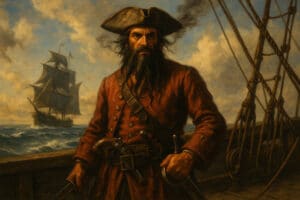
Blackbeard and the Golden Age of Piracy
When people think of Ocracoke, they think of Blackbeard. Born Edward Teach (or Thatch), he became the most notorious pirate of the early 1700s, commanding fear and fascination across the Atlantic.
Why Ocracoke?
Safe Harbor: Silver Lake Harbor (then called Cockle Creek) was deep enough for ships but hidden from open-sea patrols.
Strategic Location: From Ocracoke Inlet, pirates could intercept ships traveling to and from mainland ports.
Community Ties: Legends suggest that locals sometimes traded with pirates, exchanging supplies for goods and stories.
The Final Battle
November 22, 1718: Royal Navy forces, led by Lieutenant Robert Maynard, confronted Blackbeard at Ocracoke Inlet.
The Fight: Accounts describe a fierce, close-quarters battle. Blackbeard was wounded repeatedly before finally falling.
Aftermath: His head was hung from Maynard’s ship as proof of victory.
This dramatic ending cemented Ocracoke’s place in pirate history.
Pirate Lore Today
Teach’s Hole: A cove on the island still carries Blackbeard’s name.
Ghost Stories: Some say his spirit haunts the waters where he died.
Events: Ocracoke hosts pirate-themed festivals celebrating the island’s swashbuckling past.
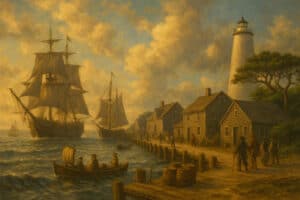
Ocracoke’s Role in Trade, Shipping, and Wartime
After the end of the pirate era, Ocracoke’s story shifted—but the sea remained at the center. From the 1700s through the 1900s, the island became a hub of trade, a strategic point during wars, and a lifeline for ships navigating the unpredictable waters of the Outer Banks.
Ocracoke Inlet – A Maritime Highway
Primary Gateway: Through the 1700s, Ocracoke Inlet was one of the few deep-water passages into Pamlico Sound, making it vital for commerce.
Imports & Exports: Goods such as tobacco, lumber, and naval stores (tar, pitch, turpentine) moved through the inlet.
Ocracoke Pilots: Skilled local mariners guided ships safely across the treacherous shoals, often risking their lives in sudden storms.
For much of the 18th century, Ocracoke was one of North Carolina’s busiest maritime hubs.
Rise of Portsmouth Village
Across the inlet from Ocracoke lies Portsmouth Village, established in 1753.
Purpose: Built as a port town to support shipping and trade.
Growth: By the mid-1800s, Portsmouth was thriving with warehouses, homes, and a hospital.
Decline: As shipping shifted to other inlets and railroads grew inland, Portsmouth slowly emptied. Today, it’s a ghost village preserved by the National Park Service.
Third time going out to Portsmouth island with the Austin’s!! Absolutely incredible as always. We had the beach to ourselves with wonderful shelling.
The Civil War Era
During the Civil War, Ocracoke’s strategic location again became critical.
Union Blockades: Federal forces blockaded Confederate ports, and Ocracoke Inlet played a role in controlling supply routes.
Local Impact: Families endured shortages, and some islanders worked with Union forces as pilots.
Skirmishes: While Ocracoke didn’t see major battles, its waters were part of the larger naval chessboard along the Outer Banks.
World War II and the U-Boats
The 20th century brought a new kind of danger: German U-boats.
The “Battle of the Atlantic”: Off the Outer Banks, U-boats sank dozens of merchant vessels in 1942. The coast became known as “Torpedo Junction.”
Ocracoke’s Role: The island’s coast watchers scanned the horizon for enemy activity, and wreckage from sunken ships sometimes washed ashore.
British Cemetery: After a British trawler struck by a U-boat sank offshore, four sailors were buried on Ocracoke. Today, their graves are honored each spring in a joint U.S.–British ceremony.
Lifesaving Stations
To counter the dangers of shipwrecks, lifesaving stations were built along the Outer Banks in the 19th century.
Purpose: Crews rescued sailors from wrecked vessels, often braving fierce storms.
Ocracoke Station: Operated until the U.S. Coast Guard absorbed the service in the early 20th century.
Legacy: Stories of daring rescues remain part of Ocracoke’s cultural memory.
Traveler’s Note
I visited the British Cemetery one spring morning, where wildflowers framed the small white crosses. It struck me how Ocracoke’s history isn’t just about pirates—it’s about real people, sailors and soldiers, who found themselves at the mercy of the sea. The island remembers them still.
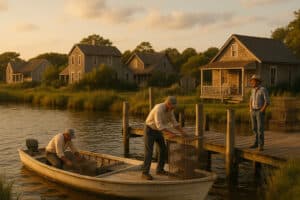
Life on the Island – Fishing, Families, and Traditions
While Ocracoke is often remembered for pirates and shipwrecks, its day-to-day history was written by ordinary island families. Fishing, boatbuilding, and tight-knit community life shaped the island’s culture long after the golden age of piracy faded.
Fishing as a Way of Life
For centuries, fishing was more than a job—it was survival.
Early Methods: Nets strung across inlets, hand-lines, and small wooden skiffs.
Seasonal Rhythms: Families harvested mullet, flounder, oysters, and clams depending on the time of year.
Community Sharing: Large hauls were often divided among neighbors, reinforcing the cooperative spirit of island life.
Even today, fishing remains part of Ocracoke’s identity, both commercially and recreationally.
Boatbuilding Traditions
Craftsmanship: Islanders built sturdy boats suited to shallow waters and shifting shoals.
Distinctive Designs: “Spritsail skiffs” became iconic along the Carolina coast.
Generational Skills: Techniques were passed down within families, and boats were often handmade with locally sourced wood.
Boatbuilding wasn’t just practical—it was a reflection of pride and ingenuity.
Family & Community Life
Life on Ocracoke was isolated for much of its history, accessible only by boat until the mid-20th century.
Self-Reliance: Islanders grew small gardens, raised livestock, and relied on trade with the mainland.
Schools & Churches: Both became central gathering points for the community.
Dialect: Ocracokers developed a unique “Hoi Toider” brogue, a blend of Elizabethan English and Southern coastal speech, still spoken by older generations.
This sense of identity helped preserve traditions even as modernity crept in.
Festivals & Folklore
Ocrafolk Festival: Celebrates local music, storytelling, and crafts every June.
Fig Festival: Honors the island’s long tradition of fig trees and the beloved fig cake.
Ghost Stories: Tales of haunted beaches and spectral ships still circulate in the community.
These events aren’t just for tourists—they’re cultural touchstones that connect islanders to their past. Many of these tales live on in Ocracoke’s ghost stories.
Traveler’s Note
I once attended the Fig Festival in August, where locals proudly handed out slices of homemade fig cake. It wasn’t just about food—it was about community, a celebration of an island that still honors its roots while welcoming visitors into the fold.
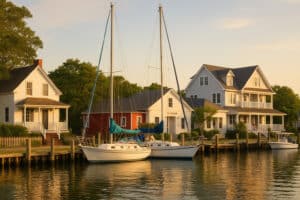
Ocracoke Today – Preserving History and Welcoming Visitors
While Ocracoke has stepped firmly into the modern era, it hasn’t abandoned its past. Walk through the village today, and you’ll see historic homes standing beside cozy inns, fishing boats moored alongside sailboats, and museums that tell stories of pirates, shipwrecks, and everyday life. The island has found a balance between honoring history and embracing tourism.
Ocracoke Preservation Society Museum
Location: A restored 19th-century home overlooking Silver Lake Harbor.
Exhibits: Shipwreck artifacts, photographs, oral histories, and local crafts.
Purpose: Preserves the island’s maritime heritage and cultural traditions.
It’s a must-visit for travelers who want to go deeper than beaches and restaurants.
We found it a fascinating museum of local history…the island ponies, full story of the notorious Blackbeard, lots of shells with their descriptions…
The British Cemetery
Significance: Final resting place of four British sailors from World War II.
Annual Ceremony: Each May, representatives from the U.S. Coast Guard and British Royal Navy honor their memory.
Why It Matters: It connects Ocracoke to global history, showing how even this small island played a role in a world conflict.
Grandkids enjoyed . No cost & easy to get to. Interesting to read old tome stones from family Cemetery.
See more reviews on tripAdvisor
Historic Sites Around the Village
Ocracoke Lighthouse: Built in 1823, it’s the oldest operating lighthouse in North Carolina.
Great example of a small lighthouse. Very well preserved with volunteer guides to explain the lighthouse. Good parking just 90 feet down the street.
Springer’s Point Nature Preserve: A maritime forest tied to Blackbeard lore, with trails leading to Teach’s Hole.
Good views of the Sound, lots of benches for sitting, beautiful and interesting woods to walk through.
Village Homes & Cottages: Many date back more than a century, offering a glimpse of traditional island life.
Cultural Tourism
Today’s Ocracoke thrives on cultural and historical tourism.
Walking Tours: Local guides share stories of pirates, legends, and folklore.
Festivals: Events like Ocrafolk Festival and the Pirate Jamboree bring history to life through music, reenactments, and crafts.
Community Spirit: Islanders often serve as storytellers, musicians, and artisans, keeping traditions alive for visitors.
Challenges & Preservation
Balancing tourism with preservation isn’t easy.
Development Pressure: Ocracoke has resisted large-scale commercial development.
Storms & Erosion: Hurricanes threaten historic sites and natural habitats.
Preservation Efforts: Local organizations and the National Park Service work to maintain trails, landmarks, and historic structures.
These efforts ensure Ocracoke’s unique character endures for future generations.
Traveler’s Note
I remember standing in Springer’s Point, listening to the wind move through the live oaks. Knowing Blackbeard once anchored here gave me chills—but so did the knowledge that locals fought to protect this land from development. In Ocracoke, history isn’t just remembered—it’s actively preserved. His final battle took place near Springer’s Point Preserve.
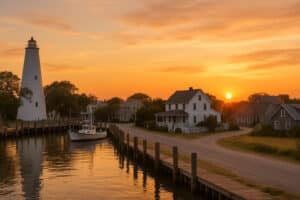
Conclusion – The Legacy of Ocracoke’s History & Legends
Ocracoke’s story is one of survival, adventure, and memory. From its earliest days as a Native fishing ground to its role in colonial trade, from Blackbeard’s fiery last stand to the quiet bravery of lifesaving crews, this island has lived through centuries of dramatic change. Yet through it all, Ocracoke has remained a place where history feels close enough to touch. To see history woven into everyday life, explore hidden artisan corners of Ocracoke.
Walk the village streets, visit the lighthouse, or stand on the shore at Teach’s Hole, and you’ll sense it—echoes of the past in every wave and whisper of wind. This isn’t history behind glass; it’s history woven into the fabric of daily life. Islanders carry their traditions forward, sharing them with visitors who come not just for beaches, but for stories.
For travelers, Ocracoke offers more than sun and sand. It invites you into a narrative shaped by pirates, fishermen, sailors, and storytellers—an ongoing tale that continues to evolve. To visit is to step into that story, and to carry a piece of Ocracoke’s legacy with you when you leave. Pirates are only part of Ocracoke’s story—explore the island’s full history, culture, and travel experiences in our Ultimate Guide to Ocracoke Island.