
The road from Reno to Las Vegas isn’t just a route between two cities; it’s a living storybook of Nevada’s history. It is one of the most fascinating historic drives between Reno and Las Vegas, where every stretch of asphalt here was once a wagon trail, a mining supply route, or a stagecoach line carrying letters, dreams, and dust. When you drive it today, you’re not only crossing desert miles — you’re following the same paths that shaped the American West. Deep-dive into old-Vegas heritage via vintage casinos and Las Vegas history.
This historic drive between Reno and Las Vegas connects more than 400 miles of mountain passes, ghost towns, and forgotten rail lines. It’s the kind of journey where gas stations double as museums and every horizon hides a legend. You can make the trip in a single day, but to truly feel it, you’ll want to linger in the places where the past still whispers. Add detours through the Southern Nevada Crossroads road trip. Travel smart during slower seasons with best off-season destinations in the USA.
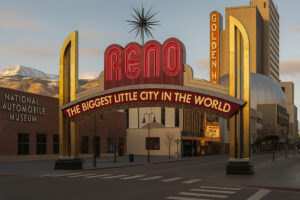
Reno – Where the Journey Begins
A City of Contradictions
Reno may be famous for bright lights and poker chips, but its roots run deep into the 19th century. Long before it was “The Biggest Little City in the World,” it was a railroad hub on the transcontinental line — the point where timber from the Sierra Nevada met silver from the Comstock Lode.
Downtown, the National Automobile Museum tells Nevada’s love affair with the open road. You’ll find everything from steam-powered carriages to the gleaming 1930s racers that once thundered across the desert. TripAdvisor reviewers call it “the best-kept automotive secret in the West.” It’s a perfect prelude to a road trip that celebrates the spirit of travel itself.
According to TripAdvisor, travelers call it “the best-kept automotive secret in the West — a stunning collection that makes you fall in love with the open road again.”
Explore National Automobile Museum on Google Maps
Historic Roads Leaving Reno
Take U.S. 395 South, which follows one of the oldest trade routes in the region — the path once used by emigrant wagons heading toward California. The road hugs the eastern base of the Sierra Nevada, giving you sweeping views of snow-capped peaks even in late spring. You’ll pass old rail towns like Washoe City, where stagecoaches once changed horses before the long climb to Virginia City.
Stop for breakfast at Peg’s Glorified Ham n Eggs, a local favorite, before rolling south toward Nevada’s capital, Carson City. The drive is short — about 30 minutes — but it feels like stepping from modern Reno into the Old West.
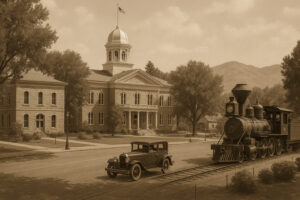
Carson City – Nevada’s Historic Heart
From Silver Boom to Statehood
Few places capture Nevada’s past as vividly as Carson City. Founded in 1858, it became the territorial capital during the Comstock mining boom and has remained the state’s seat of government ever since. Its tree-lined streets and preserved buildings make it a perfect halfway point between Reno’s energy and the desert’s silence ahead.
The Nevada State Museum, housed in the old Carson City Mint, is a must-see stop. Inside, you can still see the original Coin Press No. 1 stamping silver dollars — the same press used in the 1870s. Visitors often say the rhythmic clank sounds like Nevada’s heartbeat.
Nearby, the Nevada State Railroad Museum displays steam locomotives and wooden coaches that once carried ore and passengers through the mountains. You can even ride a short restored section of track — a taste of how travelers moved long before U.S. highways stitched the state together. Want stops, hotels, and festivals along these routes? Use Historic & Cultural Experiences in Nevada as your master guide.
Visitors on TripAdvisor say “the short ride on a century-old train makes you feel like a pioneer heading into the high desert.”
Explore Nevada State Railroad Museum on Google Maps
The Lincoln Highway Legacy
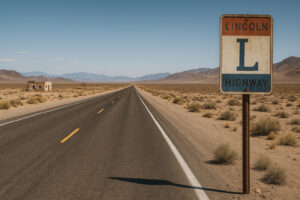
As you leave Carson City, you’ll follow what was once part of the Lincoln Highway, America’s first transcontinental road. Established in 1913, it connected New York to San Francisco — and crossed Nevada right here. Modern U.S. 50 and U.S. 95 follow much of its original path.
In Minden and Gardnerville, look for old roadside markers and plaques showing where the Lincoln Highway once wound through farmland and ranches. Some locals still refer to it as “the old coast-to-coast road.”
Before heading farther south, grab lunch in Genoa, Nevada’s oldest permanent settlement, founded in 1851. The town’s wooden boardwalks and frontier-style saloon make it feel like time never moved forward. The Genoa Bar, established in 1853, claims visitors from Mark Twain to Willie Nelson — and the mirror behind the bar survived a wagon journey from Scotland in the 1800s.
Bridgeport and the High Desert Gateway
Crossing into Stillness
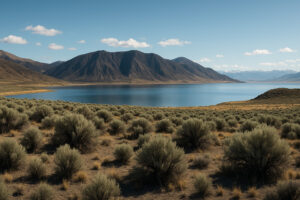
Continuing south along U.S. 395, you rise into higher desert terrain where meadows give way to sagebrush plains. Near the California border, Bridgeport Reservoir glints in the distance — a peaceful stop for photos or fishing. It’s also where early travelers once camped before tackling the rough wagon route to Aurora and Bodie, two of the most legendary ghost towns in the Sierra foothills.
Although Bodie lies just across the border in California, it’s part of the same mining story that built Nevada’s northern roads. The preserved wooden buildings, frozen in decay, show what the mining frontier looked like when fortune and ruin could trade places overnight.
Walker Lake and Hawthorne
South of Bridgeport, the road dips back into Nevada near Topaz Lake, then follows wide valleys toward Hawthorne, home of the U.S. Army Ammunition Depot and one of the largest ordnance storage sites in the world. The town’s Mineral County Museum holds a wonderful collection of frontier photographs, mining relics, and even fossils from the ancient lakebeds that once covered the area.
Walker Lake itself sits in a basin surrounded by barren mountains that glow gold at dusk. Locals say the lake’s moods shift hourly — calm one moment, wind-whipped the next. If you park near the north shore, you can often see pelicans and herons skimming the water.
The Lincoln Highway Meets the Desert
The Road to Tonopah
Leaving Hawthorne, U.S. 95 becomes a ribbon of asphalt threading through immense open country. The next major stop is Tonopah, about 105 miles south — a historic mining town that marks the halfway point between Reno and Las Vegas.
On the way, the highway crosses long, empty valleys where mirages shimmer on the horizon. Every so often, you’ll pass abandoned service stations or the skeletal remains of roadside motels from the 1940s. Many of these belonged to families who once thrived when U.S. 95 was the main north-south corridor before the interstates took over.
For travelers seeking solitude, there’s beauty in this emptiness. Pull over at one of the roadside rest areas, step out of the car, and listen — no engines, no voices, just the whisper of desert wind and the hum of heat over the sand.
Tonopah – Nevada’s Midway Memory
Silver Dreams and Desert Nights
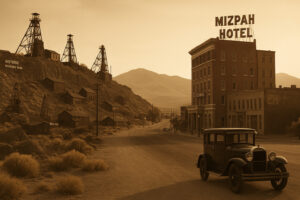
Founded in 1900 after prospector Jim Butler’s accidental discovery of silver ore, Tonopah quickly became one of the richest mining towns in the state. Today, it’s a blend of ghost town and living museum. The Tonopah Historic Mining Park sprawls across the hills above town, preserving headframes, hoists, and tunnels where thousands once worked. From the observation deck, the view stretches across the desert like an ocean of earth and light.
For travelers driving between Reno and Las Vegas, Tonopah offers a welcome pause. The Mizpah Hotel, opened in 1907, has been restored to its Gilded Age glory and still welcomes guests with creaky staircases, velvet armchairs, and stories of the “Lady in Red,” said to haunt its fifth floor. Even skeptics admit the place has personality.
At night, step outside the hotel to see one of the darkest skies in the country. The Tonopah Stargazing Park was created specifically for travelers — benches and telescopes invite you to look up at constellations that guided miners long before GPS.
Goldfield – The Golden Queen of the Desert
A City That Once Ruled the West
Leaving Tonopah behind, you drive about twenty-five miles south on U.S. 95 before the desert floor rises again into low hills scattered with stone ruins. This is Goldfield, once the largest city in Nevada.
Founded in 1902, Goldfield was the last of Nevada’s great gold rush towns. Within a few years, its population soared past 20,000, complete with electric lights, a stock exchange, and five newspapers. Presidents visited, boxers fought championship matches here, and millionaires dined in marble hotels.
Today, only a few hundred residents remain — but the town’s spirit hasn’t faded. The Goldfield Historic District is a treasure trove of crumbling brick facades, rusting cars, and stubborn dreams. Walking down Columbia Avenue feels like wandering through a silent movie set.
TripAdvisor reviewers often describe Goldfield as “eerily alive.” Locals keep the town’s story going through the Goldfield Days Festival each August, when people in period clothes parade vintage cars down Main Street and storytellers recount legends of lost mines and desert fortunes.
The Goldfield Hotel and Its Ghosts
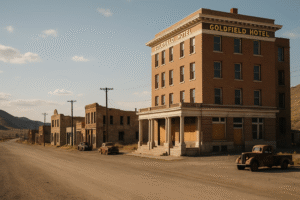
At the corner of Crook Avenue stands the Goldfield Hotel, a four-story monument to early 20th-century luxury. Built in 1908, it featured mahogany trim, crystal chandeliers, and steam heating — luxuries unimaginable elsewhere in the desert.
Now shuttered, it’s one of Nevada’s most photographed landmarks, rumored to be haunted by restless miners and the famous “Lady in Red.” Paranormal enthusiasts claim to have heard footsteps in the empty halls. Whether you believe the stories or not, standing before its grand, silent windows gives you chills.
According to TripAdvisor, visitors describe it as “majestic yet eerie — a grand relic that still watches over the desert like a sleeping queen.”
Explore Goldfield Hotel on Google Maps
The Long Road South – Highway 95
The Rhythm of the Desert
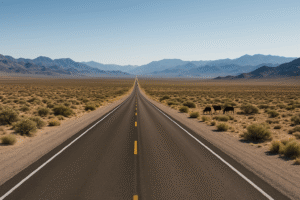
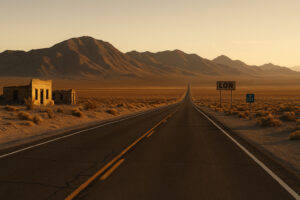
Between Goldfield and Beatty, the historic drive between Reno and Las Vegas stretches across more than a hundred miles of raw desert beauty. It’s a road of solitude — straight lines, open sky, and a horizon that keeps pulling you forward.
Every few miles, the scenery changes just enough to remind you that the desert is alive: patches of sagebrush, dry lake beds, herds of wild burros, and the occasional flash of green where springs seep from volcanic rock.
Pull over at one of the roadside markers commemorating old mining camps like Lida or Gold Point. Gold Point, about 25 miles west of U.S. 95, is a semi-preserved ghost town where a handful of residents maintain cabins for travelers. It’s part living history, part museum. You can rent a miner’s cabin, play pool in the century-old saloon, and fall asleep beneath a sky bright enough to read by starlight.
Tonopah Test Range and Modern Mysteries
As the miles slide by, you’ll pass signs for restricted areas — reminders that Nevada’s desert continues to hold secrets. The Tonopah Test Range and Nellis Air Force Range cover vast stretches of land to the east. Though not open to the public, they lend a mysterious aura to the drive. Many locals have stories about strange lights in the night sky.
The blend of ancient mining relics and modern aerospace activity gives this highway an almost mythic quality — a bridge between past and future, between the pickaxe and the jet.
Beatty – Gateway to Death Valley
An Oasis on the Edge
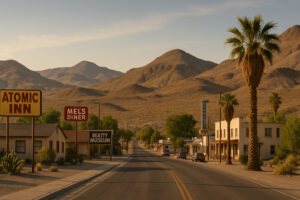
Two hours south of Goldfield, you reach Beatty, often called the “Gateway to Death Valley.” With its motels, diners, and dusty charm, Beatty feels like a traveler’s haven. It sits at the crossroads of history and geology — old mining trails meet modern adventure routes here.
Beatty began in 1905 as a supply hub for nearby mines, and remnants of those days remain in the surrounding hills. Visit the Beatty Museum and Historical Society for exhibits on mining tools, early photographs, and stories of the pioneers who braved the desert.
If you’re staying overnight, the Atomic Inn and Exchange Club Motel are retro favorites. For breakfast, Mel’s Diner serves pancakes as big as steering wheels, and the locals are always eager to share stories of desert ghosts and UFO sightings.
The Road to Rhyolite
Just a few miles west of Beatty lies Rhyolite, one of the most famous ghost towns in the West. Founded in 1904, it boomed and busted within a decade, leaving behind the haunting shell of a city that once promised greatness.
Walk through the remains of the Cook Bank Building, its stone walls still standing against the wind, or step into the Bottle House, built entirely from glass bottles in 1906. Nearby, the Goldwell Open Air Museum adds a surreal twist — modern sculptures scattered across the desert, including a ghostly white rendition of The Last Supper.
At sunset, Rhyolite glows with a golden light that makes even ruins look alive. If you listen closely, you might imagine the hum of a long-gone train rolling through the valley.

The Ghosts of the Highway
Remnants of a Changing Age
Between Beatty and Amargosa Valley, old motels, rusted neon signs, and drive-in theaters line the highway like a museum of mid-century America. Many were built in the 1940s and 1950s when families first began taking historic drives between Reno and Las Vegas for vacations instead of work.
One of the most evocative stops is the Big Dune Recreation Area, a cluster of golden sand dunes rising from the flatlands. It’s a favorite among photographers and off-roaders alike. From the crest, the landscape rolls away in every direction, silent and immense.
Nearby, the tiny community of Amargosa Valley marks the edge of Nevada’s quiet border country. The Longstreet Inn and Casino, built beside a pond with resident ducks, feels almost surreal after hours of barren desert.
Echoes of Route 95’s Past
In the early 20th century, before interstate highways simplified navigation, this corridor carried traders, military convoys, and dreamers alike. Roadside diners thrived, their neon signs glowing through dust storms. Today, a few remain — such as the Area 51 Alien Center, a bright-green building on U.S. 95 that welcomes travelers with extraterrestrial humor and surprisingly good coffee.
Many dismiss it as a novelty stop, but it’s also a tribute to Nevada’s decades-long fascination with mystery. The desert may look empty, but its stories are endless.
Ash Meadows – The Desert’s Unexpected Garden
A Living Oasis
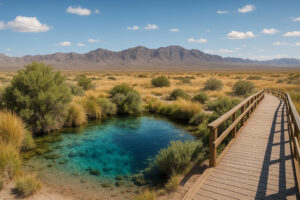
Before reaching Las Vegas, take a side trip to Ash Meadows National Wildlife Refuge, a place so different from the surrounding desert it feels like another world. Crystal-clear springs, wetlands, and desert pupfish — a species found nowhere else — fill this protected area with rare life.
Walk the Crystal Spring Boardwalk, where turquoise water bubbles up from underground aquifers. Interpretive signs tell how these springs once guided Native American travelers and early pioneers alike. It’s hard to believe such vivid color exists amid so much brown and gold.
The Amargosa Opera House
In nearby Death Valley Junction, just across the California border, stands the Amargosa Opera House, a pink stucco building founded by artist Marta Becket in the 1960s. She performed solo ballet and theater shows here for decades, often to an audience of painted murals when no one else came. Her story is one of devotion — to art, to place, and to the solitude of the desert.
Today, volunteers keep the building open for visitors. Walking through its hand-painted interior feels like stepping inside a dream where art defies isolation.
Pahrump and the Western Gateway
Crossing into New Light
Leaving Amargosa Valley behind, the desert begins to change. The land opens into a vast plain surrounded by low mountains glowing pink at dawn. The town of Pahrump rises slowly out of the dust — a name derived from the Southern Paiute term pah-rimpi, meaning “water rock.”
Pahrump may look like a modern pit stop, but it’s one of the most historically significant waypoints between Reno and Las Vegas. In the 1800s, it was a watering hole on the Old Spanish Trail, connecting California’s missions to Santa Fe’s trade routes. Today, travelers stop here to refuel, rest, or taste the desert’s unexpected bounty.
The Pahrump Valley Winery, surrounded by vines that thrive in sandy soil, offers tastings paired with stories of settlers who believed grapevines could tame the desert. A few miles away, the Pahrump Museum preserves mining and ranching artifacts from early settlers who braved this harsh valley.
Ash Meadows to Red Rock
Driving east, you pass the edges of Red Rock Canyon National Conservation Area, where sandstone cliffs rise dramatically from the Mojave floor. For many travelers, this is the moment they realize how close ancient wilderness lies to the city that never sleeps. Pull into one of the scenic overlooks near Blue Diamond Hill — the silence feels older than civilization itself.

Las Vegas – The Southern Terminus of History
From Railroad Stop to Desert Empire
Arriving in Las Vegas after hundreds of miles of open highway feels almost dreamlike. The city’s neon glow signals not just arrival, but transformation. It began as a railroad stop in 1905, a cluster of tents and wooden shacks near a spring-fed creek. By the 1930s, with the construction of Hoover Dam, Las Vegas became a bustling town of workers and entrepreneurs.
Those who travel the historic drive between Reno and Las Vegas retrace this evolution in real time — from silver boom to electric light, from wagon to highway.
To truly end your journey where it began — in history — skip the Strip and head downtown to Fremont Street. The Mob Museum, housed in the former U.S. Post Office, offers an unflinching look at organized crime’s influence on early Las Vegas. The Neon Museum, just a few blocks away, glows each evening with restored signs from the city’s golden era — Stardust, Moulin Rouge, Sahara.
Locals often suggest ending your drive at Main Street Station, one of the most historically detailed hotels in the city. Inside, authentic antiques from around the world decorate every hallway — including stained-glass panels from the Pullman cars of 19th-century trains.
TripAdvisor reviewers often describe it as “the best history museum you can sleep in.”
The Circle Completed – Reno to Las Vegas in Spirit
The Road as a Time Machine
Driving from Reno to Las Vegas is like reading Nevada’s autobiography. Every town — Tonopah, Goldfield, Beatty — writes a different chapter. The road you travel today sits atop trails carved by explorers, widened by miners, and paved by dreamers.
In an age where GPS guides us effortlessly, this trip reminds you what travel once meant: uncertainty, wonder, and the joy of finding life in places where maps once showed only blank space.
A Traveler’s Reflection
When I first made this drive, I expected to see desert and emptiness. What I found was a living archive. The ruins, the restored hotels, the endless horizon — all pieces of a story that belongs not only to Nevada but to everyone who has ever chased a destination and found themselves somewhere unexpected.
The highway doesn’t end at Las Vegas; it continues in the stories you tell afterward. In your photographs, your conversations, and that quiet moment when you look at the horizon and realize the desert changed you — just as it changed the people who came before.

Road Trip Tips and Essentials
When to Go
Spring (March–May): Wildflowers bloom, weather is mild.
Fall (September–November): Perfect temperatures and golden desert light.
Winter: Clear skies, fewer crowds, cold nights but magical mornings.
Summer: Travel early or late; midday heat exceeds 100°F.
Best Stops for Photos
The Goldfield Hotel ruins at sunrise.
Rhyolite’s Bottle House and sculptures.
Walker Lake at dusk.
Red Rock Canyon under stormy clouds.
Essential Items
Extra water and snacks (services can be 100 miles apart).
Tire inflator, spare, and paper maps.
A camera with manual settings for night skies.
A notebook — you’ll want to record what words can’t describe.
Frequently Asked Questions About Historic Drives Between Reno and Las Vegas
About 7–8 hours without long stops. Plan for 2–3 days if you want to explore Goldfield, Tonopah, and Rhyolite.
Yes, though it’s remote. Carry water, fuel, and a charged phone. Locals are friendly, and traffic is light but steady.
Tonopah’s Mizpah Hotel, Goldfield’s Main Street, Rhyolite Ghost Town, and the Neon Museum in Las Vegas.
Yes, but check weather near Walker Lake and Tonopah — snow occasionally dusts higher elevations.
It follows the path of the old Lincoln Highway and early mining trails that connected Nevada’s boomtowns to the railroads.
Yes. The Mizpah Hotel (Tonopah) and Goldfield RV Park are classic mid-route stays. Beatty and Pahrump also offer modern hotels.
Most are reachable by regular vehicle, though some roads near Gold Point and Rhyolite are gravel. Check local maps for conditions.
Early morning and late evening when light turns the mountains copper and shadows stretch long across the valley.
Yes, remnants run through Carson City, Fallon, and Ely, often marked by interpretive signs and plaques.
Because it’s one of America’s last great open highways — a journey that turns history, solitude, and discovery into something unforgettable.