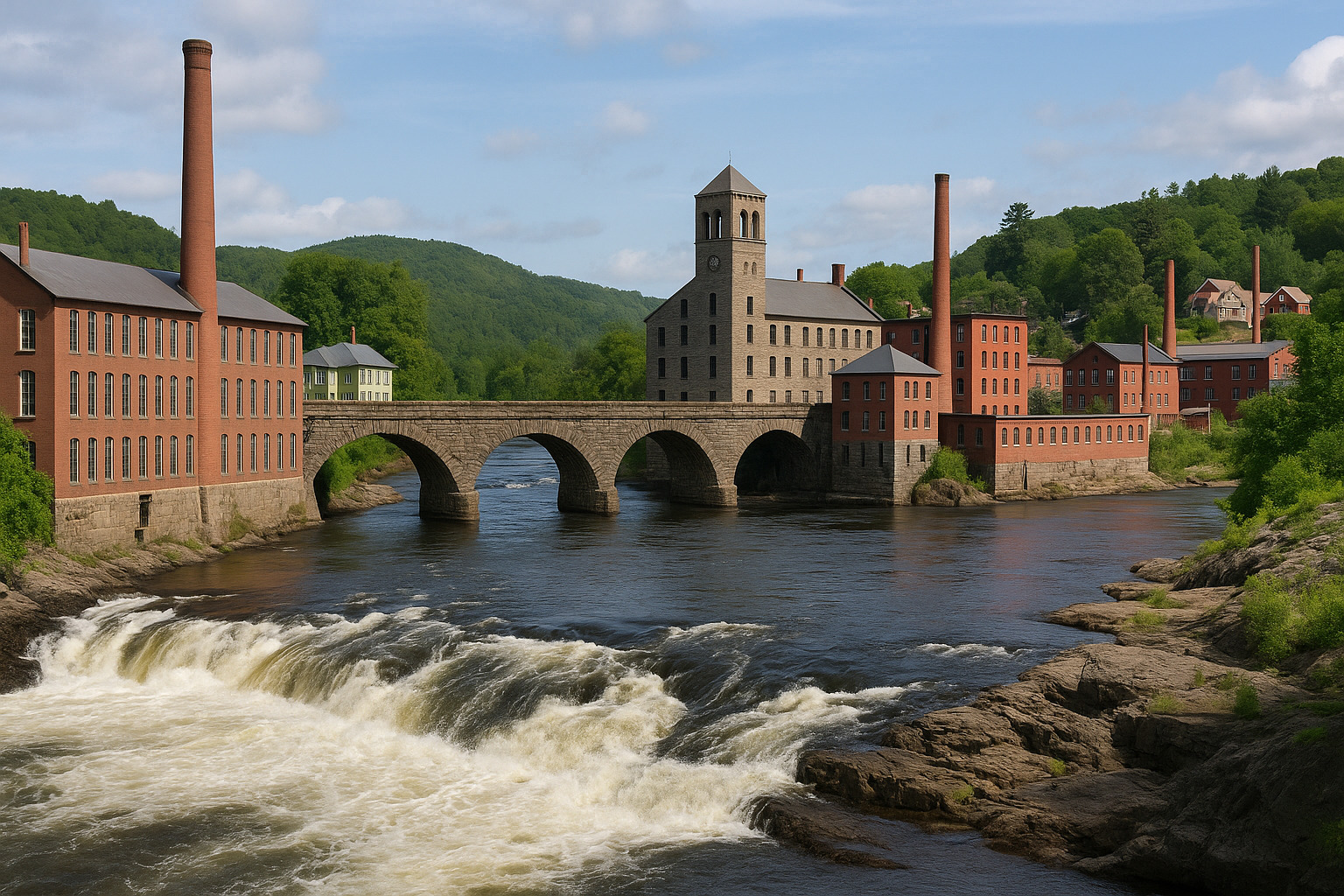
Some towns are built around progress; others are built around persistence. Bellows Falls, VT, belongs to the latter. Nestled along the banks of the Connecticut River in the Town of Rockingham, this historic village doesn’t simply preserve the past — it continues to live it.
From the hum of 19th-century mills to the whistle of passing trains, Bellows Falls Vermont history is written in the rhythm of its river. Every brick warehouse, canal stone, and iron bridge tells a story of how ingenuity shaped a small town into one of New England’s most remarkable industrial legacies.
I came here not expecting a lesson in American industry, but that’s what Bellows Falls became — an open-air classroom on how communities evolve, adapt, and endure.
The Origins – Water, Settlement, and the Power of the River
Before industry, there was only the river — and the people who understood its voice. Long before Europeans arrived, the Abenaki people fished these waters for salmon, shad, and sturgeon. They called the spot “Great Falls,” a reference to the thunderous cascades that once filled the valley with mist.
The first settlers arrived in the mid-1700s, drawn by the same thing that drew the Abenaki — the river’s power. Early gristmills and sawmills sprang up along its banks, using waterwheels to grind grain and cut timber. The community that formed around them became part of the Town of Rockingham, officially chartered in 1753.
The combination of fertile farmland and the Connecticut River’s current created a perfect environment for growth. By 1800, Bellows Falls was more than a farming outpost — it was becoming a small but ambitious trading center. For scenic perspectives of the same rivers that powered these mills, explore Scenic Walks and Riverside Trails Near Bellows Falls.
The Bellows Falls Canal – Birth of an Industrial Town
The turning point came with one of America’s earliest engineering marvels: the Bellows Falls Canal. Completed in 1802, it transformed the region’s economy overnight.
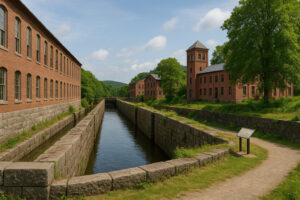
Before the canal, the Great Falls were a barrier — boats couldn’t navigate the dangerous rapids. The canal bypassed this obstacle through a series of hand-cut granite locks, allowing cargo to flow freely between northern Vermont and Massachusetts.
The project was massive for its time. Workers used chisels, pulleys, and sheer determination to carve the canal from solid rock. When it opened, Bellows Falls became a critical shipping point for lumber, grain, and manufactured goods.
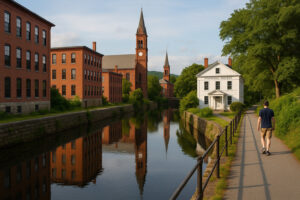
Even now, walking along the Canal Street Historic District, you can see remnants of that early vision — stone retaining walls, rusted iron fittings, and interpretive markers that tell the story of men who dug progress out of bedrock.
The canal didn’t just move goods; it moved imagination. Soon after its completion, entrepreneurs realized that the same waterpower that carried boats could also drive machinery.
This art gallery is a gem. It sits in a historic building overlooking the Bellows Falls Canal, one of the first canals in the country.
See more reviews on Tripadvisor
From Water to Wheels – The Rise of the Mills
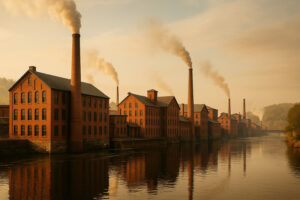
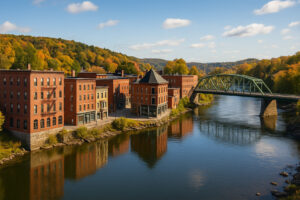
By the mid-1800s, Bellows Falls VT had evolved into a classic New England mill town. The canal water was diverted to run turbines, powering sawmills, paper mills, and textile operations. The riverbanks filled with smoke stacks and red-brick factories, their reflections shimmering on the current below.
One of the town’s earliest successes was the Moore & Thompson Paper Mill, established in the 1840s. It produced fine paper from local wood pulp and became a cornerstone of the town’s economy for over a century.
Nearby, the Fall Mountain Paper Company and other smaller operations turned Bellows Falls into one of Vermont’s leading paper-manufacturing centers. At its peak, thousands of residents worked in these mills, creating the rhythmic heartbeat that defined the town’s identity.
In those days, the air smelled faintly of pulp and river mist, and the sound of machinery echoed across the valley. Local newspapers described Bellows Falls as “a place where water and willpower meet.”
The Railroad Revolution
The second industrial transformation came not by water, but by rail. In 1849, the Vermont Valley Railroad connected Bellows Falls to Brattleboro and beyond. Soon after, the Rutland & Burlington line intersected here, linking the village with New York and northern Vermont.
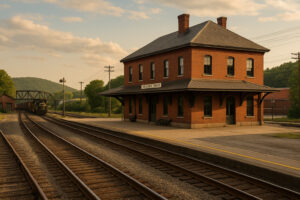
This crossroads of rails turned the Town of Rockingham VT into a transportation hub. Factories could now ship goods faster, cheaper, and farther than ever before. The Bellows Falls Depot, built in 1851, became one of the busiest stations in the region — a gateway between rural Vermont and the larger industrial world.
For travelers today, standing on that same platform feels like stepping through time. The original brick depot still stands, and Amtrak’s Vermonter line continues to make daily stops, bridging past and present.
The Boom Years – Prosperity and Progress
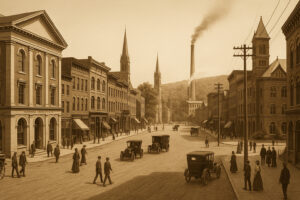
By the late 19th century, Bellows Falls had entered its golden age. Prosperity brought more than money — it brought architecture, culture, and civic pride.
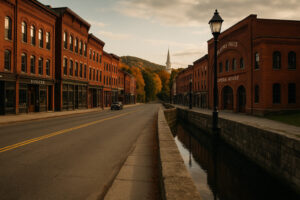
Downtown filled with Greek Revival and Italianate-style buildings, many of which still grace The Square today. The Bellows Falls Savings Institution, established in 1851, financed both industry and personal dreams. Schools, churches, and theaters appeared, signaling the town’s transition from rugged frontier to polished center of commerce.
Electricity arrived early — powered, fittingly, by the river itself. The Bellows Falls hydroelectric plant became one of Vermont’s first, lighting homes and factories before many rural communities had even heard of electric lamps.
By 1900, the village had grown into a vibrant industrial ecosystem — paper, textiles, grain milling, printing, and rail service all thriving together. It was a model of self-sufficiency, the kind of place where the mill whistle marked not just time, but identity.
A Town of Workers and Dreamers
Every industrial town has its heroes — inventors, builders, and everyday workers who kept the gears turning. In Bellows Falls Vermont history, the stories of these people form the town’s truest legacy.
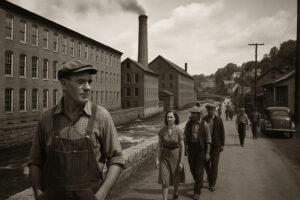
Generations of families worked the same factory floors. Fathers taught sons to mend machinery; mothers kept ledgers or stitched textiles. Wages were modest, hours long, but there was dignity in the labor.
At night, workers filled local diners and taverns, sharing stories of floods, blackouts, and progress. The Town of Rockingham became a tapestry of cultures — Irish immigrants, French-Canadians, and Yankees all bound together by the rhythm of the mills.
Even today, descendants of those first factory families still live in Bellows Falls. Their pride isn’t nostalgia; it’s continuity — a quiet acknowledgment that what their grandparents built still stands. Learn how nearby towns evolved alongside Bellows Falls in Hidden Stories of Rockingham VT: River Town Heritage.
The 20th-Century Shift – Decline and Resilience
No industrial story is without its downturn. By the 1950s, automation and global competition began to weaken local manufacturing. One by one, the mills fell silent. Jobs vanished, and the town faced the same uncertainty that swept across America’s industrial heartland.
But Bellows Falls refused to surrender. Instead, it adapted.
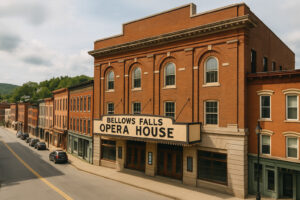
Empty mills became opportunities rather than eyesores. The community repurposed historic buildings into galleries, performance venues, and co-working spaces. The Bellows Falls Opera House, which opened in 1926 and nearly closed in the 1970s, was lovingly restored and now stands as a cultural anchor.
This Movie theater is one of the best original theaters around. Look at there web sight for events and movies. 550 seat capacity . Renovation of all sorts . Very nice place to spend an evening
See more reviews on Tripadvisor
The Rockingham Arts and Museum Project (RAMP) transformed the downtown into an artist’s haven. What had once been a town of laborers became a town of creators — still hardworking, but now with brushes, guitars, and chisels instead of machines.
Bellows Falls entered the modern era not as a relic, but as proof that identity can evolve without erasing its foundation.
Preservation and Recognition
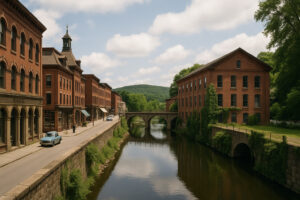
In 1982, the Downtown Bellows Falls Historic District was added to the National Register of Historic Places, protecting dozens of buildings and canal structures. This recognition wasn’t just about architecture — it was about story.
Local historians and volunteers cataloged every mill, canal gate, and bridge, ensuring future generations would understand the town’s role in shaping Vermont’s economic and cultural landscape. The preservation movement also sparked tourism, as visitors sought authentic experiences in places that hadn’t been overtaken by modernization.
Today, walking through downtown feels like reading a living textbook. The old bank buildings now house antique shops, bakeries, and studios. The canal path still hums faintly with the memory of moving water. And from the Village Bridge, you can see how nature has slowly softened the edges of industry, wrapping steel and stone in vines and silence.
Rockingham’s Role – The Parent Town’s Influence
It’s impossible to understand Bellows Falls without recognizing its parent community, the Town of Rockingham VT.
Rockingham encompasses not only Bellows Falls but several surrounding villages, each contributing to the region’s shared history. From its earliest days, the town supported education, craftsmanship, and civic engagement. It was Rockingham’s charter that allowed Bellows Falls to grow, and its residents who invested in the canal and rail projects that changed Vermont forever.
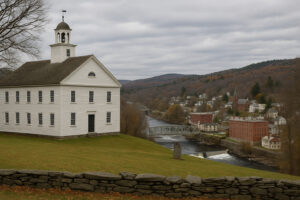
The Rockingham Meeting House, built in 1787, still stands on a hill overlooking the valley — one of the oldest unchanged public buildings in the state. It symbolizes what both Rockingham and Bellows Falls value most: endurance and preservation.
Together, they represent the dual spirit of Vermont — industrious yet independent, traditional yet progressive.
Cultural Renaissance – From Industry to Inspiration
The 21st century has seen Bellows Falls re-emerge as a hub for creativity. The same buildings that once echoed with machines now pulse with art, music, and innovation.
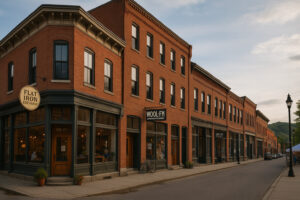
The Exner Block, once a textile warehouse, houses artist studios and the community radio station WOOL-FM, where locals share stories and music. The Flat Iron Exchange, located in one of the town’s most iconic triangular buildings, blends coffee culture with creativity — a symbol of how Bellows Falls continues to evolve.
Community events like Bellows Falls 3rd Fridays, featuring art walks, outdoor music, and food vendors, draw visitors from across Vermont. Even the Bellows Falls Historical Society has become interactive, hosting storytelling nights where residents share personal memories of working in the mills or living through the floods of 1927 and 1936.
This blend of heritage and creativity ensures that the town’s past is never static — it moves, adapts, and breathes through those who call it home.
Why History Still Matters Here
In an era obsessed with the new, Bellows Falls VT reminds us why history matters. It’s not nostalgia that drives preservation; it’s understanding.
Walking along the canal trail, you see how human effort once tamed nature — and how nature now gently reclaims it. Touring the Opera House, you sense the continuity of entertainment and community. Visiting the Historical Society, you see how small-town resilience can outlast economic tides.
Each generation adds a layer to Bellows Falls Vermont history — from the industrial founders to the artists and entrepreneurs of today. And together, they prove that progress doesn’t always mean replacing the old; sometimes it means reimagining it.
Traveler’s Reflection – Learning from the Past
I often tell readers that Bellows Falls isn’t just a stop; it’s a lesson. Its story mirrors that of America itself — innovation, expansion, struggle, and reinvention.
If you visit, take time to wander slowly. Listen for the hum of the old factories. Feel the cool stone of the canal under your hand. Step inside the Opera House or the small shops that occupy historic storefronts. You’ll discover that the soul of Bellows Falls has never been trapped in time — it’s simply paced differently, measured not in decades but in stories.
I’ve walked through many Vermont towns, but this one feels most alive with echoes. It carries the weight of what was built and the hope of what’s still becoming. In the end, that’s what makes Bellows Falls VT extraordinary — it remembers.
Plan Your Visit
Curious when to visit historic landmarks at their most photogenic? Check our Bellows Falls Weather and Best Times to Visit.
Location: Town of Rockingham, Windham County, southeastern Vermont
How to Get There: Direct Amtrak Vermonter service; 2.5 hours from Boston via I-91
Best Time to Visit: May–October for walking tours and canal trails; December for the Winter Festival
Nearby Highlights: Saxtons River Village, Grafton Cheese Company, Mount Ascutney State Park
Explore Historic Bellows Falls, Vermont on Google Maps
Final Thoughts
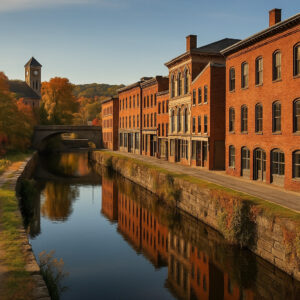
Some places preserve history behind glass. Bellows Falls Vermont preserves it underfoot, in walls, and in the air you breathe. It’s a living record of how water, work, and willpower built a community that still stands proud in the heart of Rockingham.
When you leave, you carry its story — a reminder that progress isn’t only found in new skylines, but also in the quiet endurance of old ones. To see how these industrial roots shaped the wider town’s culture and scenic charm, explore our main guide to Bellows Falls, Vermont: Hidden History & Scenic Escapes.
Frequently Asked Questios About Bellows Falls Vermont History
Because it pioneered early canal engineering and became one of the state’s first industrial centers powered entirely by water.
Primarily paper, textiles, and rail transport. The mills and canal system defined its economy for more than a century.
Yes, many remain as restored landmarks or creative spaces, especially along Canal Street and The Square.
Bellows Falls is part of the larger Town of Rockingham VT and serves as its commercial and cultural center.
Walk the Canal Trail, visit the Historical Society, and attend a show at the Opera House — all within walking distance downtown.