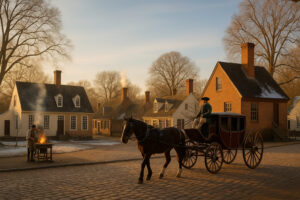
Few places in the United States blur the line between past and present like Colonial Williamsburg. The moment you enter, the hum of traffic fades, replaced by the rhythmic clop of hooves and the crackle of iron in a forge. Exploring the rich Colonial Williamsburg history feels less like visiting a town and more like stepping through a doorway in time.
When I first arrived, the winter air carried the scent of wood smoke and bread baking somewhere unseen. A costumed interpreter greeted me not with a rehearsed welcome, but with a warm “Good day.” That simple greeting marked the beginning of a journey—not through a museum, but through a living community that still honors the ideas that built a nation. To experience how Williamsburg fits within the broader heritage corridor of Virginia, start with our Historic Triangle Itinerary linking Williamsburg, Jamestown, and Yorktown.
Colonial Williamsburg is more than preserved streets and brick walls; it’s an experience that teaches without lecturing. Every corner tells a story, and every story invites you to imagine yourself in it.
Explore Colonial Williamsburg Historic Area on Google Maps
Why Colonial Williamsburg Still Matters Today
History isn’t static. It breathes through interpretation and participation—and Williamsburg proves that better than anywhere else. This city allows travelers to feel the tension, hope, and creativity of the 18th century by living it firsthand.
The site represents one of the largest outdoor living history museums in the world, covering over 300 acres and more than 500 buildings. Yet what matters most is its message: that liberty and democracy weren’t born fully formed—they were argued, tested, and earned by ordinary people.
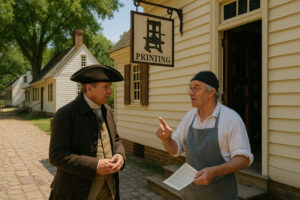
For me, that message felt especially relevant during a conversation with a re-enactor portraying a printer. He spoke about the power of words in colonial Virginia: “Once ink touches paper, ideas spread faster than orders.” It was a reminder that freedom has always depended on communication and courage.
From Middle Plantation to Capital City
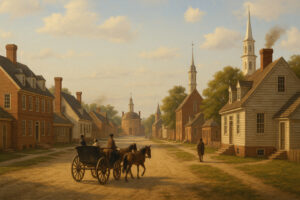
Before it became a symbol of American heritage, Williamsburg was known as Middle Plantation, a small settlement founded in 1632 on high ground between the James and York Rivers. Its strategic location protected inhabitants from disease-ridden marshes and hostile coastal raids.
By 1699, after Jamestown was devastated by fire and disease, the colonial government moved its capital to Middle Plantation and renamed it Williamsburg, honoring King William III. You can explore the colony’s beginnings and early struggles in our Jamestown Settlement History guide. The town was carefully planned with a grid layout centered on Duke of Gloucester Street and flanked by the Capitol and the College of William & Mary.
For the next eighty years, Williamsburg became a center of politics and education. Laws were written here; sermons and debates lit the spark of revolution. When the capital moved to Richmond in 1780, Williamsburg fell silent—but its structures and spirit remained, waiting to be revived.
Restoring the Past – The Rockefeller Vision
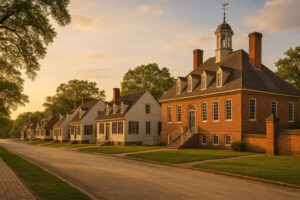
By the early 1900s, many colonial buildings were in ruins. Enter Reverend W. A. R. Goodwin, rector of Bruton Parish Church, whose passion for preservation changed everything. He dreamed of restoring Williamsburg to its 18th-century glory and found an ally in philanthropist John D. Rockefeller Jr.
Together they began the largest historical restoration project ever attempted in the United States. Between 1926 and 1950, over 700 modern structures were removed and hundreds of colonial buildings either restored or faithfully reconstructed on their original foundations.
Goodwin once said, “If history can speak through place, then this city will speak for centuries.” And it does. Their vision turned a forgotten town into a national treasure—one that balances authenticity with education and welcomes millions each year.
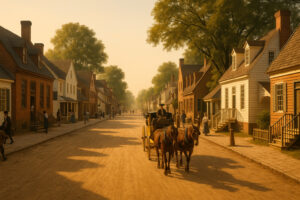
Duke of Gloucester Street – The Pulse of the City
Every journey through Colonial Williamsburg begins with a walk down Duke of Gloucester Street, often called “DoG Street.” It runs nearly a mile from the Capitol to the College of William & Mary, and every step feels like passing through layers of time.
I started my morning here with coffee from a nearby tavern before joining a horse-drawn carriage ride. Shops lined the street: the silversmith polishing spoons, the wigmaker chatting about fashion, children playing with wooden toys. It’s a street that tells its story not through plaques but through daily life.
Each building reveals a different aspect of the 18th century — from law to medicine to trade. What impresses most is the sense of scale; these were not grand mansions for the elite alone but a true city where carpenters, bakers, and students coexisted in a shared rhythm.
Explore Duke of Gloucester Street, Williamsburg, VA on Google Maps
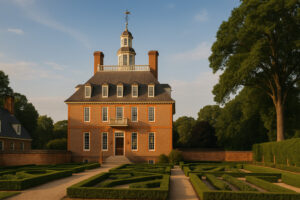
The Governor’s Palace – Power, Elegance and Politics
Dominating the north end of DoG Street, the Governor’s Palace once symbolized imperial authority. Inside, hundreds of weapons form a decorative display in the entry hall—a reminder that order was maintained by force as much as law.
Tours reveal lavish dining rooms, crimson walls, and ballrooms where the colony’s elite gathered. During the Revolution, the Palace was briefly home to Patrick Henry and later used as a military hospital. The restoration captures both its grandeur and its fragility.
Standing on the terrace overlooking its gardens, I understood why governors believed architecture was politics in brick. Every angle impressed authority and order upon those who entered.
Both kids and us very much enjoyed the guided tour through the Governor’s palace.
Explore Governor’s Palace, Colonial Williamsburg on Google Maps
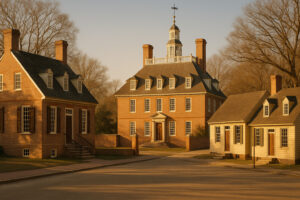
Architecture of the Colonies – Brick, Wood & Symbolism
Williamsburg’s buildings speak their own language. The neat symmetry, central doorways, and multi-pane windows reflect the Georgian style—imported from England but adapted to Virginia’s climate and resources.
Brick was a sign of status and permanence. Wood was for humility and function. You can see both coexisting in a single block: the Governor’s Palace radiates authority, while the joiner’s shop shows simple craftsmanship.
Architectural details also held meaning. Fanlights above doors symbolized enlightenment; orderly rows of windows echoed rational thought. Even color choice was deliberate — deep reds for power, earth tones for virtue.
As I walked the streets, I realized that these designs weren’t just aesthetic—they reflected a philosophy of balance and reason that still shapes American identity.
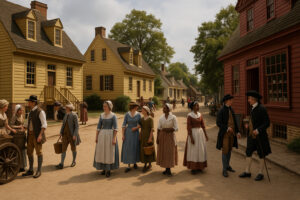
The People of Williamsburg – Merchants, Artisans & Citizens
The story of Colonial Williamsburg belongs to its people. Every profession, every accent, every custom formed the city’s pulse.
Merchants traded tobacco, silks, and spices with London. Artisans crafted every necessity by hand — from candles to carriages. Students argued philosophy in coffeehouses while farmers brought produce from nearby plantations.
The streets were alive with diversity long before the word became fashionable. German immigrants introduced new crafts, Scottish traders brought music and whiskey, African labor underpinned the economy. Every group left its mark on language, architecture, and food.
Spending time with the reenactors who represent these voices today feels like meeting ancestors through conversation. Each persona is rooted in research and lived storytelling — not fiction but resurrection.
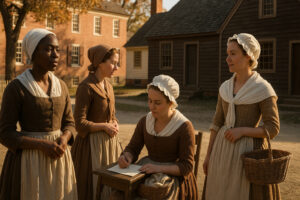
Women of Williamsburg – The Untold Voices
History often celebrates its men, but Williamsburg’s women were its backbone. Merchants’ wives kept books and negotiated credit when ships ran late. Midwives and healers kept families alive through fever and childbirth. Teachers ran small academies for girls when formal education excluded them.
Reenactments now introduce figures like Ann Wager, who operated the Bray School for African American children, and Mary Stith, a free Black woman who owned property on Francis Street. Their stories prove that agency existed in many forms, even under restriction.
One afternoon I listened to a presentation called “Voices of Women,” where interpreters spoke from letters and journals of the era. Their words cut through time — not as politics, but as daily survival, grace, and resilience.
Understanding these women adds layers to Williamsburg’s identity. It was never a city of great men alone—it was a city held together by great women whose names we’re finally learning to say.
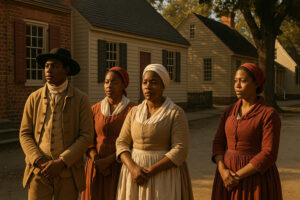
Enslaved & Free Black Communities – Stories of Resilience
The hardest truth about Colonial Williamsburg is that its beauty was built on enslaved labor. By 1775, half the town’s population was African or African American, both enslaved and free. They farmed, cooked, crafted, and taught skills that sustained the colony — yet for centuries, their voices were erased.
Today, the “Freedom’s Paradox” tour confronts that history honestly. Guides share archival records and family stories of those who worked in the Governor’s Palace, tended gardens, or fought for freedom alongside patriots who still enslaved them.
One reenactor told me, “We don’t speak for the past — we let it speak through us.” Standing there, I felt the weight of that mission. Williamsburg’s greatest lesson may be its ability to face truth without losing hope.
These stories redefine colonial history not as a single narrative of freedom, but as a complex struggle for it. That honesty makes the city feel alive — because only when we acknowledge every voice does history become complete.
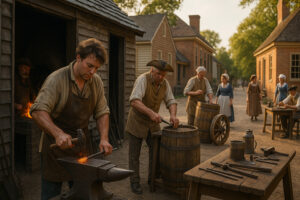
Trades & Skills That Built a Nation
No classroom can teach craftsmanship the way Colonial Williamsburg does. Every clang of a hammer or hiss of hot iron tells how survival once depended on skill.
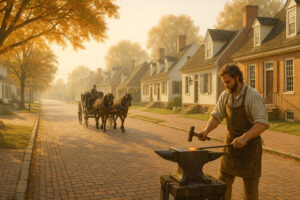
The blacksmith’s forge glows from dawn to dusk. I watched an apprentice hammer out a perfect nail, sweat glistening as the master nodded approval. Nearby, the cooper tightened barrel hoops, the wheelwright planed oak spokes, and the tinsmith shaped lanterns by hand.
What struck me most was the rhythm of labor. These artisans weren’t just demonstrating—they were living their trades. Their patience reminded me how modern convenience has shortened our attention spans. In the 18th century, creation required time, repetition, and pride.
Trade shops also served as centers of gossip and politics. News from London arrived in crates and was shared over workbenches. The same men who shaped iron discussed liberty, taxes, and the future of the colonies. Craft and conversation built a revolution together.
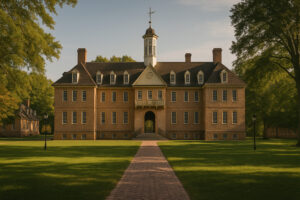
Education and Enlightenment – The College of William & Mary
Founded in 1693, the College of William & Mary stands as the intellectual twin of Williamsburg’s political heart. Its Wren Building is the oldest academic structure still in use in the United States, and stepping inside feels like entering a cathedral of learning.
Students here once studied Latin, philosophy, and moral law by candlelight. Professors such as George Wythe, America’s first law teacher, trained future revolutionaries—Jefferson, Monroe, and Tyler walked these same halls.
I joined a campus tour led by a current student who spoke passionately about continuity: “Every generation leaves its argument behind.” That line stayed with me. Knowledge isn’t stored in books alone; it lives in questions we still dare to ask.
Beyond academics, the college was a social hub. Balls, debates, and scientific demonstrations filled evenings. In 1769, a student club even built one of America’s earliest theaters, proving that intellect and creativity flourished side by side in colonial Virginia.
Faith, Music & Theatre in the 18th Century
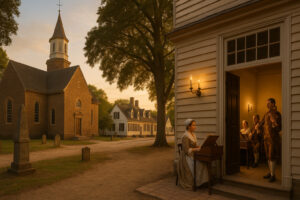
Williamsburg’s colonial society moved to a soundtrack of bells, hymns, and laughter. Faith anchored life, but entertainment gave it color.
Very worthwhile to see, hear and feel Colonial Williamsburg, steeped in history and tradition and ghostly encounters; truly an amazing part of old American culture; recommended.
See more reviews on Tripadvisor
Bruton Parish Church
Consecrated in 1715, Bruton Parish Church remains a place of worship today. Sitting in its pews, you feel the blend of solemnity and hope that shaped the Revolution. The church’s registry still lists names of patriots who prayed here before signing their bold declarations.
Music in the Colonies
Music echoed everywhere—from military parades to tavern corners. Fife-and-drum corps rehearsed marches that once stirred troops toward independence. Inside taverns, fiddlers played Irish reels while locals danced on wooden floors slick with candle wax.
During my visit, I attended an evening concert where performers used period instruments—harpsichord, violin, recorder. Their melodies filled the hall with warmth, reminding us that even in turbulent times, people sought harmony.
Theatre & Public Expression
The Williamsburg Play House once staged Shakespeare and colonial comedies for eager crowds. Theatre was more than amusement; it was debate in disguise, a safe space to mock kings and celebrate new ideas. When actors performed Cato, a play about liberty, the audience heard more than drama—they heard prophecy.
Museums & Archaeology – Preserving What Was Lost
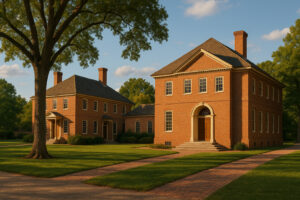
Colonial Williamsburg’s power lies partly in what lies beneath your feet. Archaeologists have unearthed thousands of artifacts—buttons, pipes, ceramics—that rebuild forgotten lives.
The DeWitt Wallace Decorative Arts Museum
Here you’ll find ornate furniture, glassware, and textiles once owned by Virginia’s elite. Each object whispers stories about wealth, taste, and trans-Atlantic trade. Seeing these items up close shows how refinement mingled with practicality; beauty served function.
The Abby Aldrich Rockefeller Folk Art Museum
Across the courtyard, self-taught artisans take the stage—whittled figurines, vibrant portraits, handmade toys. Their simplicity carries sincerity. When viewed together, the two museums prove that America’s early art came from every class, not just the privileged.
Archaeological Sites
Ongoing digs near the Armoury and Market Square continue to rewrite history. I spoke with a volunteer who said, “Every shard is a sentence from someone’s life.” That sentence sums up Williamsburg’s ethos: preserve details, and the story will tell itself.
Colonial Williamsburg Tours & Reenactments
The best way to feel the city’s heartbeat is to join its performances.
Revolutionary City Program
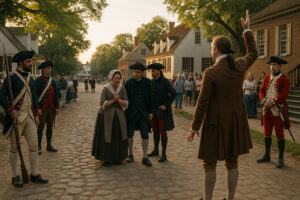
This moving reenactment unfolds across the streets. Actors become townspeople debating independence, mourning loss, or arguing loyalty. I once stood among a crowd watching a mock trial; the accused pleaded loyalty to the king while neighbors jeered. The emotion felt raw, unscripted, and unforgettable.
Specialized Tours
Freedom’s Paradox: Explores slavery and freedom in the colonies.
Colonial Foodways: Shows how meals were cooked using hearths and copper pots.
Garden Walks: Focuses on 18th-century horticulture and symbolism.
Night Experiences
At sunset, lanterns appear and voices lower. Ghost tours blend folklore with documented accounts, reminding visitors that memory outlives its makers. One guide told me, “The past never left; it just waits for someone to listen.”
Modern Comforts in a Historic Setting
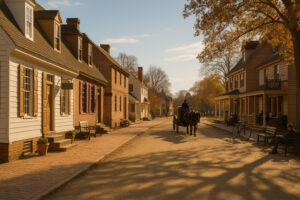
Balancing authenticity with accessibility defines Williamsburg’s success. Cobblestone walks meet Wi-Fi cafés, and horse carriages share space with shuttle buses. Between these towns, the Colonial Parkway Scenic Drive connects history with nature through one of Virginia’s most peaceful routes.
Visitors can stay in restored colonial houses with hidden climate control or in nearby boutique hotels that echo 18th-century design. Streets remain pedestrian-friendly, encouraging slow exploration.
This coexistence between centuries doesn’t feel forced. Locals call it living continuity—the idea that honoring the past should make the present richer, not heavier. Whether you’re buying handmade soap or sipping locally roasted coffee, you’re participating in that balance.
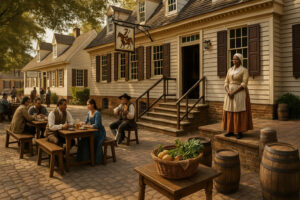
Food & Hospitality – Taverns, Recipes & Traditions
Dining here isn’t about hunger—it’s about heritage. After exploring the Historic Area, unwind with a glass of Virginia wine using our Wineries, Breweries & Farm-to-Table Dining in Williamsburg.
Historic Taverns
Chowning’s Tavern offers cheerful disorder—mugs clinking, fiddles playing, jokes exchanged across tables. King’s Arms Tavern brings refinement with candlelight dinners of venison pie and syllabub.
Colonial Flavors Reimagined
Local chefs reinterpret centuries-old recipes using regional produce. At Blue Talon Bistro, I ordered peanut soup, a dish tracing back to African roots that entered colonial kitchens through enslaved cooks. One taste connected continents and centuries in a single spoonful.
Markets & Seasonal Fare
Saturday mornings draw crowds to the Williamsburg Farmers Market where farmers sell honey, herbs, and handmade cheese. The exchange feels as vital today as it did in 1770 — community meeting economy under open sky.
Food in Williamsburg tells stories of adaptation: how English techniques merged with African spices and Native ingredients to create uniquely American flavors.
Evenings, Ghosts & Legends Under Lantern Light
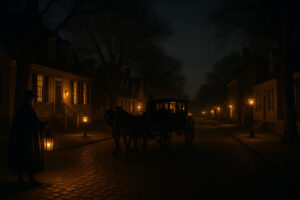
As night descends, Colonial Williamsburg transforms. Gaslights flicker, cobblestones gleam, and the city exhales a century’s memories.
Lantern Tours & Haunted Histories
Guides dressed in cloak and tricorn lead groups through silent streets, telling tales recorded in letters and ledgers. The story of the Ludwell-Paradise House—where visitors claim to see candle flames dance without wind—gave me chills.
Music After Dark
Evenings often end with live fife-and-drum performances or colonial dances. Couples waltz where governors once held banquets, and for a moment you forget which century the music belongs to.
Moments of Stillness
My favorite memory is simpler: sitting alone near the Capitol after closing hours. The moonlit street was empty except for the creak of an unseen sign. I realized then that the past never fully disappears; it lingers quietly, patient and alive.
Traveler Tips & Personal Reflections
Practical Tips
Arrive early: Morning light is soft and photos shine.
Use the multiday pass: Exploring slowly reveals more connections.
Talk to interpreters: Every conversation adds context you won’t find online.
Wear comfortable shoes: The district covers 300 acres of brick paths.
Visit in shoulder seasons: Spring and autumn offer mild weather and fewer crowds.
For more ideas on where to eat, stay, and explore nearby nature trails, visit our full Williamsburg, Virginia Travel Guide for insider tips and seasonal itineraries. Stay close to the colonial streets you just walked — find the perfect inn or historic suite in our Williamsburg Bed-and-Breakfast Guide.
Reflections
Each visit teaches something new. The first time I came, I focused on politics; the second, on people; the third, on silence. Williamsburg rewards those who return because it is not a place of conclusion but continuity.
Watching a blacksmith shape iron, I saw a metaphor for history itself: heated, hammered, and refined until it takes enduring form. That is what this city does —it shapes our understanding of who we are. When the holidays arrive, see how the town transforms in Grand Illumination & Christmas Town: Williamsburg’s Holiday Magic.
Final Thoughts – What Williamsburg Teaches Us Today
Colonial Williamsburg stands as a bridge between memory and modern life. Its streets teach that freedom was forged not by perfect heroes but by flawed humans seeking better ways to live together.
In an age of speed and distraction, this town invites you to slow down—to walk, listen, and consider. You begin thinking you’re visiting the past, but you leave understanding the present.
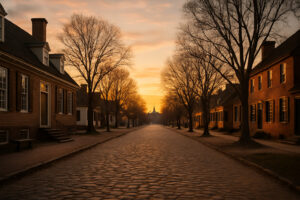
When I took one last look down Duke of Gloucester Street at sunset, the light caught on brick and window glass until the whole town seemed to glow. That image stayed with me—a reminder that history, when cared for, never fades; it simply waits for new eyes to see it.